
Opening Recognition
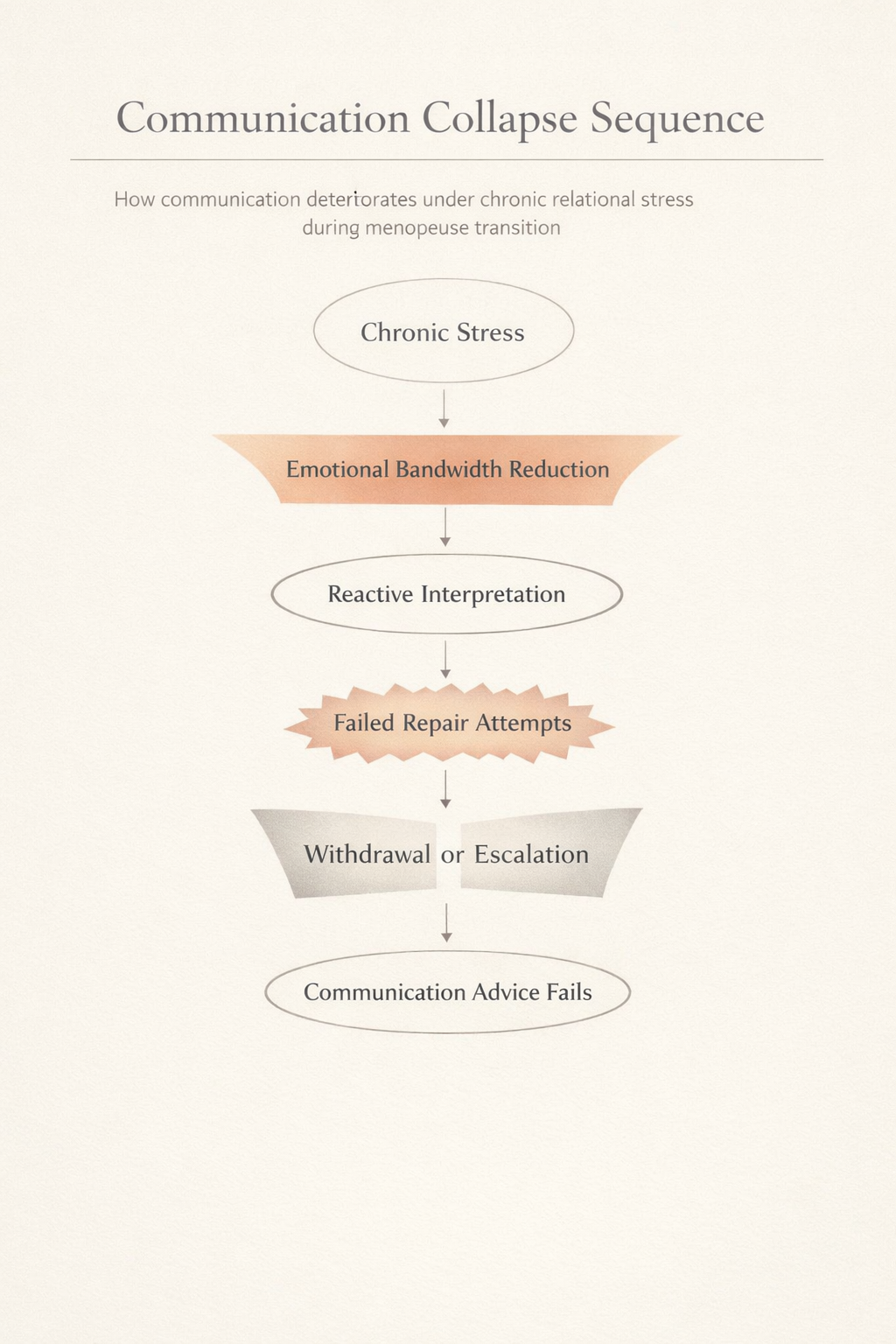
The conversation begins with a script. It has been rehearsed, internally, with a careful selection of words designed to be unaccusatory. It is an attempt to use the tools, to follow the advice for better communication. The opening line is delivered with deliberate calm, an “I feel” statement intended to open a door. But the door does not open. Instead, a stillness enters the room. The response that comes back is quiet, compliant, and utterly devoid of texture. It is an agreement without energy, a concession without connection.
Another attempt is made. This one is met with a similar flatness, a short answer that technically addresses the question but offers nothing more. The person who initiated the conversation is now managing not only their own feelings of frustration, but the effort of carrying the interaction for both of them. The person responding is not being hostile. They are simply not there. The exchange ends, not in a fight, but in a quiet, mutual retreat into silence. The tool did not work. The conversation resolved nothing. The distance feels slightly wider than before.
The Common Assumption
It is an article of faith in modern relational life: the solution to distance is better communication. When connection frays, the assumed cause is a deficit in communicative skill or willingness. The problem is located in the way things are being said, the way listening happens, or the failure to do either with sufficient care. From this perspective, the path forward is behavioral. It involves learning new techniques, practicing more empathy, and applying more effort to the craft of talking and listening.
This assumption is powerful because it is logical and because it offers a sense of agency. If the problem is skill, then the solution is practice. If the problem is effort, the solution is to try harder. The belief is that with the right words and a patient tone, the underlying issue can be surfaced, understood, and resolved. The frustration experienced by couples in this state is therefore compounded: they are applying the prescribed solution, often with great discipline, and the condition is not improving. Sometimes, it is getting worse.
The Hidden System Dynamic
What is often mistaken for a communication failure is better understood as a capacity problem. The issue is not the technique; it is the condition of the system in which the technique is being deployed. When a relational system is operating under sustained, cumulative stress — what can be called Relational System Stress — its fundamental ability to process interaction changes. The system does not have enough functional reserve to support the kind of interaction it is being asked to produce.
Emotional bandwidth — the finite capacity to process relational and emotional demand — begins to contract. Reactive thresholds lower. The margin for error in interpretation narrows. Under these conditions, communication advice that assumes full availability of attention, regulation, and generosity will consistently underperform. The advice is not wrong. The conditions it requires no longer exist. Asking two people in this state to communicate with greater skill is not unlike asking an overloaded electrical circuit to carry more current. The request is coherent. The conditions make it unworkable.
The Accumulation of Load
This state of systemic overload is rarely the result of a single event. It is the product of accumulation. It is the sum of unacknowledged logistical management, the invisible labor of tracking household needs, the cognitive weight of career pressures, the slow-drip stress of aging parents, and the profound, often disorienting, biological realities of the menopause transition itself. This accumulation of what is often an Invisible Relational Load depletes the system's reserves quietly, over a long period of time. By the time the depletion manifests as a “communication problem,” the underlying resource crisis is already well-established. The problem seen is a symptom, not the cause.Pattern Development
Over time, a depleted system will often settle into a predictable, self-reinforcing pattern. One common expression is a complementary dynamic of overfunctioning and withdrawal. Faced with a lack of responsiveness, one partner may increase their efforts. They initiate more conversations, do more research on communication strategies, and take on more of the emotional work of the relationship. This is not a bid for control. It is an anxious attempt to stabilize a system that feels increasingly precarious.
In response to this increased pressure, which itself requires energy to process, the other partner may retreat further. Their withdrawal is not a withholding or a punishment, though it is almost always interpreted that way. It is a protective maneuver in a system that has no available energy. The person withdrawing is often experiencing their own internal state of overwhelm, and the partner’s well-intentioned attempts to “talk it through” are experienced as another demand on a critically low resource. The attempt to optimize interaction becomes another source of systemic load. Each person is responding rationally to the system as they experience it. Their responses are also making the overall problem worse.
Why Traditional Advice Often Fails
Communication techniques are optimization strategies. They are designed to refine and improve an existing, functional baseline of interaction. Active listening, structured feedback, and “I-statements” are sophisticated tools. But like any sophisticated tool, they require certain conditions to be effective. They presuppose available cognitive resources, a degree of emotional regulation, and a reservoir of goodwill.
In a system defined by depleted capacity, these preconditions are absent. Attempting to use an optimization tool in a non-functional environment is not just ineffective; it can be counterproductive. The act of trying to communicate “correctly” becomes a performance. It adds a layer of cognitive demand—am I saying this right? am I using the right tone?—to an already-taxed brain. This performance of connection feels hollow, and both partners know it. The failure of the technique is then internalized as another personal or relational failing, reinforcing the very cycle of stress it was meant to break.
The Misapplication of Tools
A tool used outside its operating parameters tends to do damage. Applying communication advice to a system that needs stabilization, not optimization, is a categorical error. It misdiagnoses the problem and therefore prescribes an intervention that the system cannot absorb. The couple is left with the confusing and demoralizing experience of doing the “right” thing with ever-greater effort, only to find themselves more exhausted and further apart. They are not failing at communication. They are trying to optimize a system that is failing structurally.Stabilization and Reframe
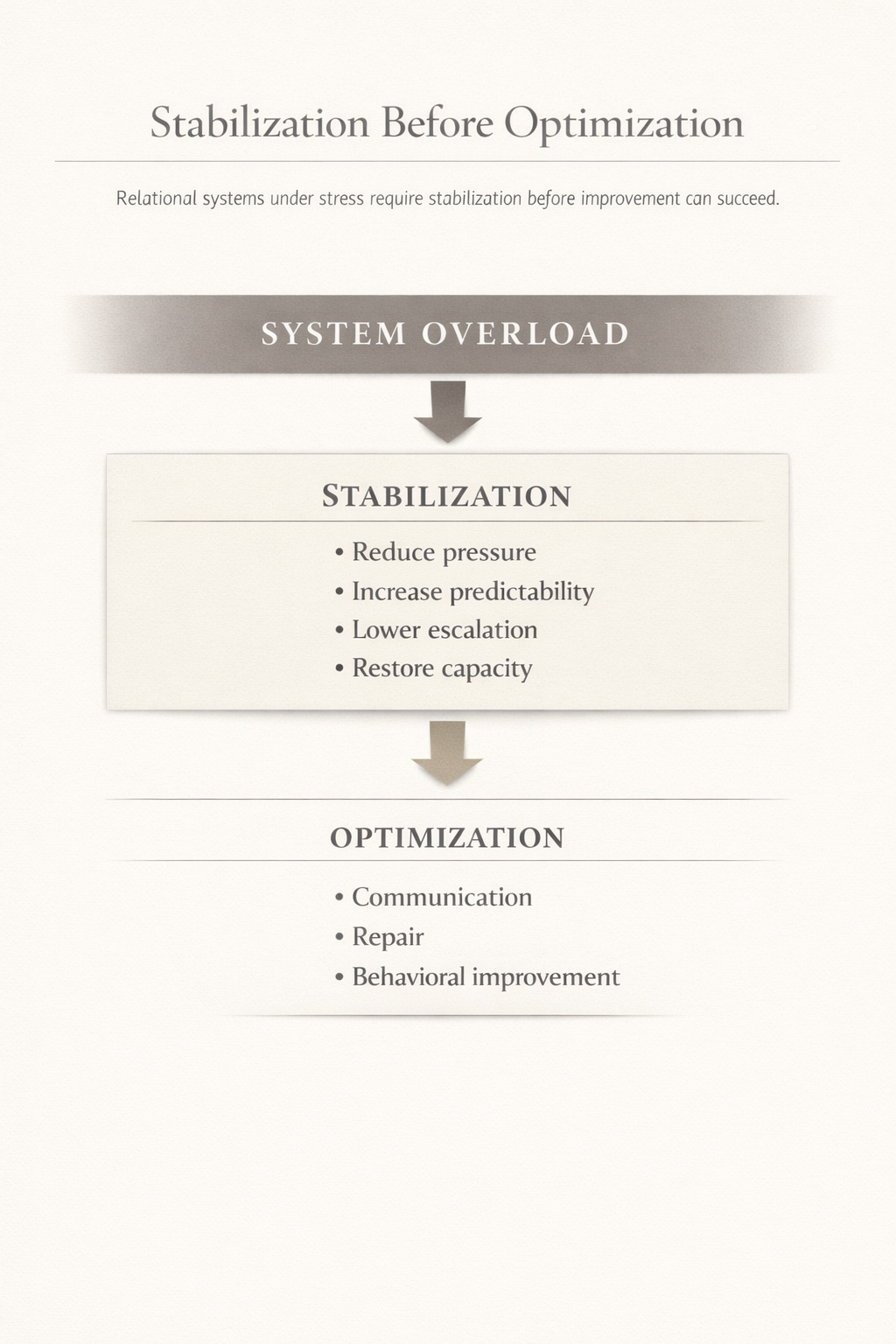
The necessary reframe is to shift the goal from optimization to stabilization. Before communication can be improved, the system's resource drain must be slowed or stopped. Stabilization means reducing the overall load on the system. It is not about adding a new skill, but about removing demands. This can take many forms: consciously tabling difficult conversations, simplifying logistics, reducing social obligations, or creating pockets of time with no expectation of productive engagement. The focus shifts from solving the relational problem to creating conditions where solving anything becomes possible again.
This is not an intuitive or satisfying answer. It asks for less, not more, effort. It requires a tolerance for unresolved tension while the system regains some minimal level of equilibrium. Acknowledging that the system cannot currently support a difficult conversation is a difficult conversation in itself. The path to stabilization is not always clear, and the process can feel like a retreat rather than progress. It may not feel like a solution at all.
Closing Reflection
Understanding the system does not immediately change it. Recognizing that a relationship is under structural stress rather than behavioral failure does not dissolve the exhaustion or repair the distance. The insight itself provides no immediate warmth. The explanation, however accurate, may change nothing about the silence that settles this evening. It is a particular kind of quiet knowledge.
What it alters is the story told about that silence. Misreading a system problem as a personal failure produces one kind of response — rooted in blame, frustration, and escalating attempts to fix. Recognizing it as a system problem produces another. Neither guarantees resolution. Recognizing the nature of the problem does not obligate the system to respond.