
Opening Recognition
The question is simple. It is five words: “Do we have more trash bags?” And the response, which remains internal, is anything but. It is a surge of something that feels like anger but is heavier than that. It is a flash of every related inventory item: the paper towels that are low, the dish soap that was not on the last grocery list, the fact that the recycling needs to go out tomorrow morning, a task that now also feels like it belongs entirely to one person. The physical sensation is one of weariness so profound it borders on a kind of despair. The request for the location of the garbage bags lands not as a question, but as an indictment.
To the person asking, it is just a question about trash bags. To the person hearing it, it is confirmation of a truth they have been trying to ignore: that they are the sole keeper of the household inventory, the logistical brain, the one who knows where things are because they are the one who is always tracking them. Many people feel this way. It was not the trash. It was never the trash.
The Common Assumption
Internal shifts can be seen personally. For the person feeling the changes inside, there is often a feeling of failure: "I am overreacting," or "I am too sensitive." Thoughts like, "This is hormones, it's not logical, it means I am not handling things well," can come up. For the partner who asked a question, the feeling is also personal, but aimed outward: "She is so irritable these days," or "Everything bothers her." The thought, "I cannot ask a simple question without an edgy reply," may occur.
Both interpretations locate the problem inside a person. They diagnose a flaw in character or mood. The assumption is that if the person could just regulate their emotions better, or if their partner could just be more considerate, the friction would cease. It presumes the interaction is the problem. This is a reasonable conclusion. It is also almost always incomplete.
The Hidden System Dynamic
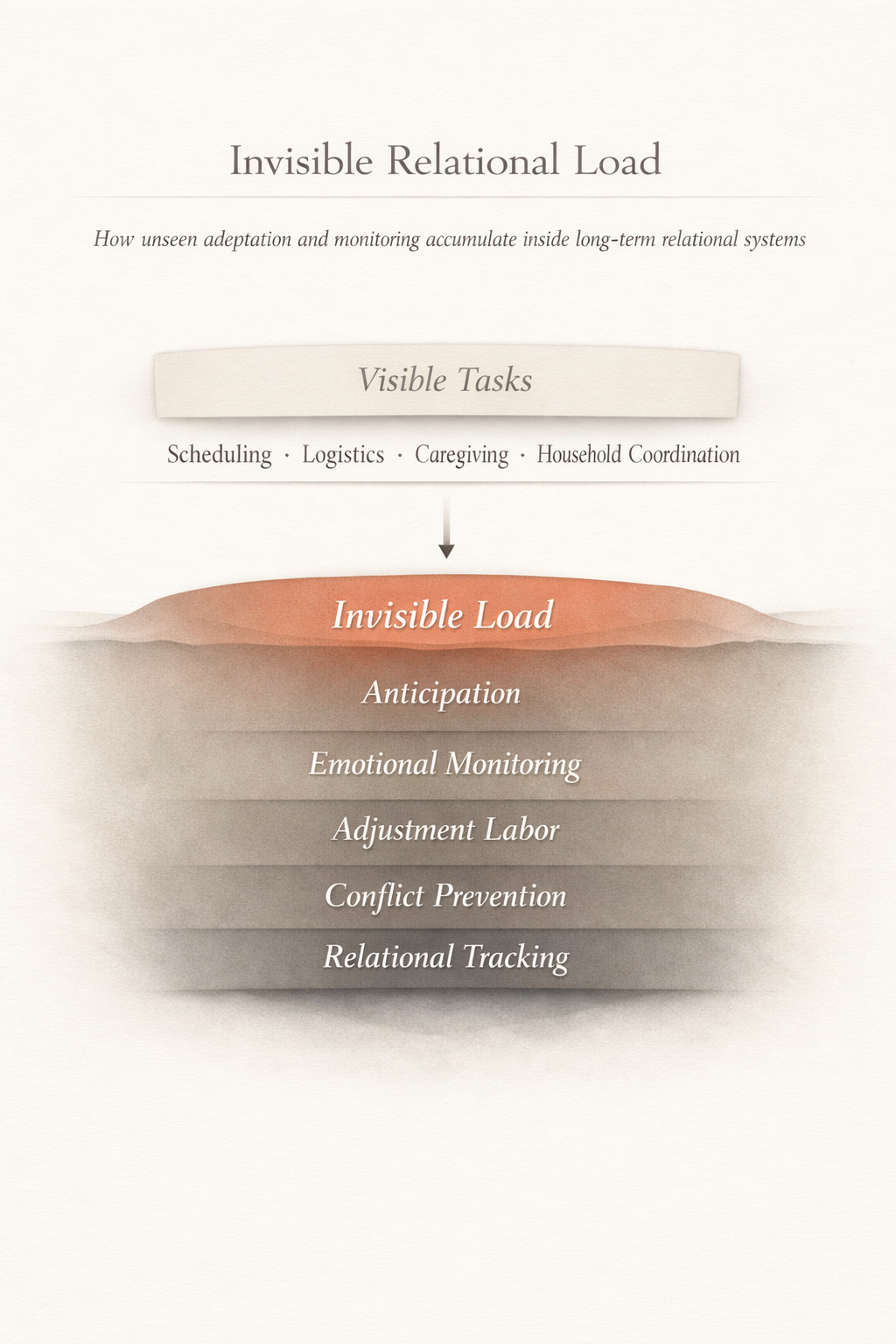
What feels like a personal failing is more accurately described as a systemic event. The friction is not the result of an outsized reaction, but the sudden, painful visibility of a previously invisible workload. This is the experience of Invisible Relational Load: the accumulation of cognitive, logistical, and emotional labor that is performed but not seen, named, or shared.
This load is the constant, low-level hum of management. It is knowing the school schedule, the dietary needs, the social obligations, the date of the last oil change, and the location of the trash bags. It is the work of anticipating needs before they arise, of tracking the emotional temperature of the household, of holding the mental map for the entire operation. It is not just doing the tasks, but the responsibility for knowing the tasks exist in the first place. For a long time, a relational system can absorb this imbalance. One person carries the load, and the system functions. No one sees it. It just works.
Pattern Development
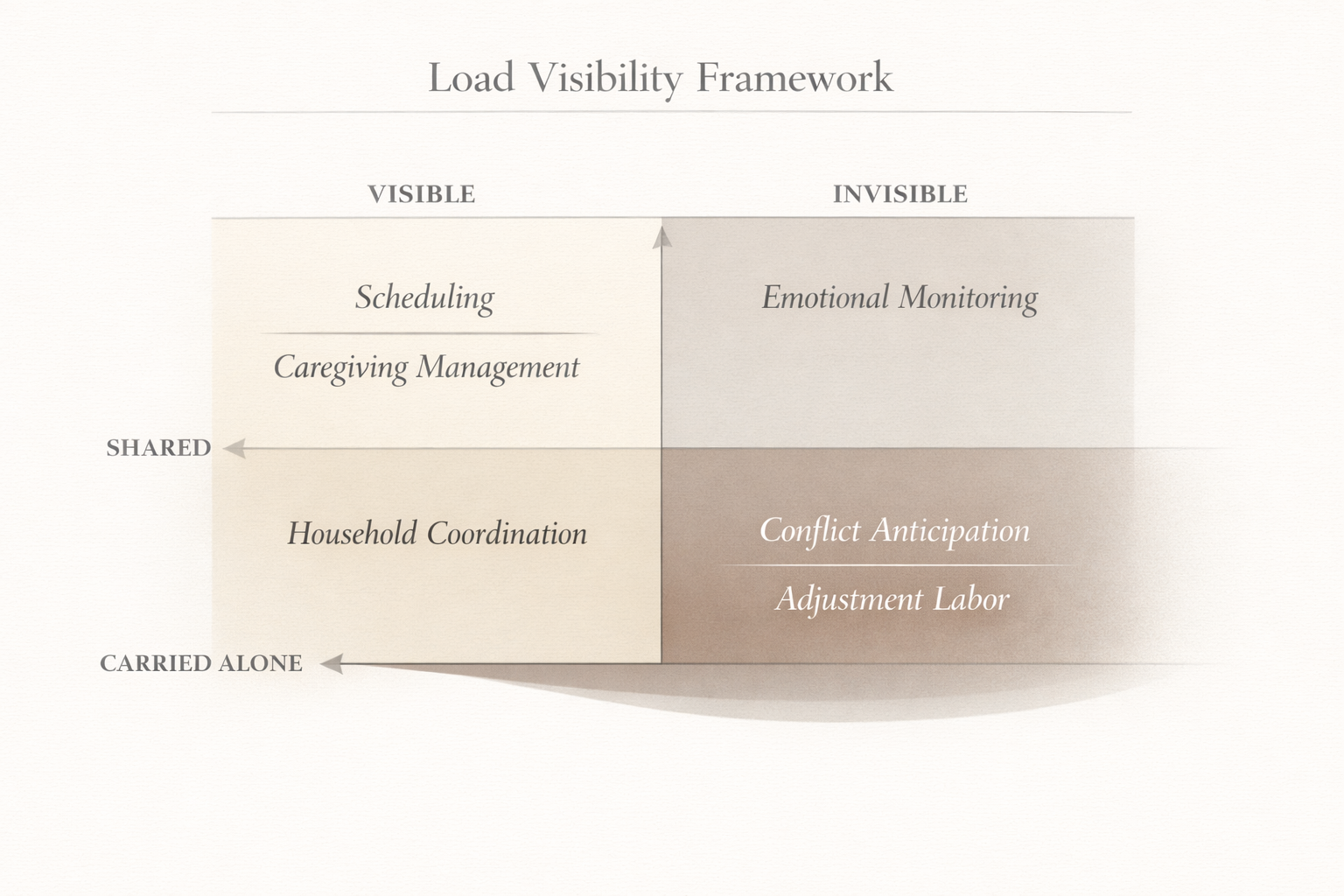
The distribution of this invisible work is rarely a conscious decision. It accretes over years, settling into a pattern of default. One partner, often through a combination of social conditioning and personal aptitude, becomes the designated manager. The other partner, in a complementary move, comes to rely on that management. They do not have to know where the trash bags are because someone else always does. They can relax into a state of not knowing, which is its own form of relief.
One of the most textured moments in a long-term relationship is watching your partner read a book on the sofa, fully absorbed and at rest, while your own mind is running three parallel tracks of logistical planning for the coming week. There is no malice in their relaxation. There is no virtue in your planning. It is simply the system operating as designed. But during midlife transition, when one’s own internal resources—cognitive sharpness, emotional bandwidth, physical stamina—begin to contract, the previously manageable weight of this invisible load can become abruptly, crushingly heavy. The system has not changed. But the capacity of the person carrying it has.
Why Traditional Advice Often Fails
This is why communication-based advice often underperforms. The suggestion to “just ask for what you need” or “delegate more” overlooks a critical reality: delegation is not abdication of responsibility. It is another management task. To ask for help, one must first identify the need, break it down into a communicable task, assign it, and then often oversee its completion. This does not reduce the cognitive load. In some cases, it increases it.
This is not simply emotional overwhelm. It is the accumulation of invisible relational labor that is no longer being absorbed by the system. Asking the person carrying the load to communicate it more clearly is like asking a computer with insufficient RAM to solve the problem by describing its slowness more eloquently. The description is not the issue. The issue is capacity. And the request to describe it consumes more of the very resource that is already depleted.
Stabilization and Reframe
What is often mistaken for personal overreaction is better understood as a structural deficit. The system has come to rely on a level of invisible work that the carrier is no longer able to provide without significant cost to her own stability. The flashes of anger or deep weariness are not mood swings; they are system alerts. They are the notification that the load exceeds the available resources.
This reframe shifts the question. It moves from “What is wrong with me?” or “What is wrong with us?” to “What is the invisible structure of this system, and why is it no longer working?” This does not produce an immediate solution. Making the invisible visible is disorienting work, for both partners. It requires looking at the mechanics of the relationship, which can feel less personal and also more intractable. Many couples find the behavioral problem easier to name, even if it resists all attempts at repair.
Seeing the imbalance does not correct it. It only names it. What follows that naming is its own separate and uncertain process, one that the system may or may not be equipped to handle.
Closing Reflection
To understand that your exhaustion is not a personal failure but a systemic condition does not make you less exhausted. Recognizing the weight of an invisible load does not, in itself, make the load any lighter. It may, for a time, make it feel heavier, because now it has a name and a shape. It is no longer a diffuse sense of being overwhelmed, but a specific, structural imbalance that is now impossible not to see.
There is no simple path from this recognition to a different relational reality. The work is not in communicating needs more effectively, but in fundamentally renegotiating the unseen architecture of a shared life. That is a much larger, slower, and more difficult conversation. Some systems are not ready for it. What changes, in the beginning, is only the interpretation. And sometimes, for a while, that has to be enough.