
Opening Recognition
There is a point in the evening when the day’s logistics are done and the house falls quiet. One person sits on the sofa, scrolling through a phone, the light from the screen illuminating a face at rest. The other stands at the kitchen counter, wiping it down for the third time, while a silent, scrolling list runs in their head: the car needs gas for the morning commute, the form for school must be signed, a reminder needs to be set for the pharmacy refill. A question hangs in the air, unasked: does anyone else see what needs to be done?
The person on the sofa might look up and ask, “Is anything wrong?” and the answer, “No, I’m fine,” is true enough in the moment and also entirely false. This is not a scene of conflict. It is a scene of profound and growing distance, a quiet imbalance that has become the very structure of the relationship. One partner seems to be carrying more, seeing more, doing more. The other seems to be drifting further into a space of passive observation. The system is imbalanced.
The Common Assumption
When this dynamic becomes entrenched, it is almost always interpreted as a problem of character. The partner who is managing everything is seen as controlling, anxious, or a micromanager. They cannot let things go. They have to have it their way. The partner who has disengaged is seen as lazy, selfish, or checked out. They do not care enough to help. They are content to let someone else handle the load.
From this perspective, the solution appears to be behavioral correction. The overfunctioning partner should learn to relax and ask for help. The withdrawn partner should learn to step up and be more responsible. These interpretations place the blame squarely on the individuals, framing the issue as a set of personal failings. Resentment builds on one side, and a sense of being perpetually criticized builds on the other. Both feel misunderstood. Both are, in a way, correct.
The Hidden System Dynamic
What is often perceived as one partner's controlling behavior and the other's apathy is more accurately a complementary pattern born of systemic overload. This is not a failure of personality. It is a predictable response when the demands on a relational system exceed its capacity.
The Accumulation of Invisible Load
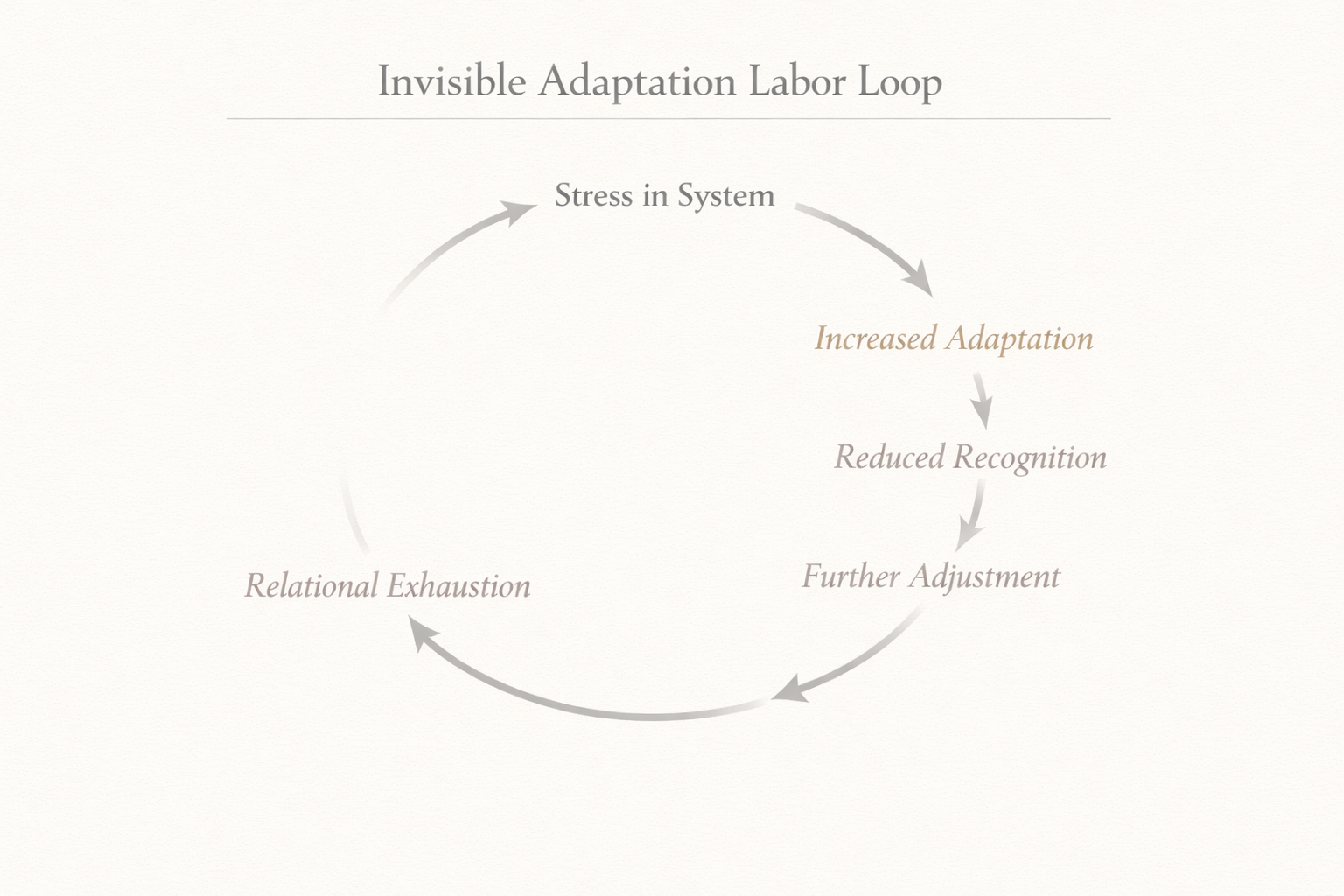
Much of the work that sustains a household and a relationship is invisible. This is the Invisible Relational Load: the cognitive effort of planning, organizing, and anticipating needs; the emotional labor of monitoring the family’s well-being, soothing anxieties, and managing social connections. During midlife, as parental care, career pressures, and physiological changes from menopause converge, this load often expands dramatically. As it accumulates, it consumes a person's available Emotional Bandwidth—the finite capacity to process and respond to emotional and logistical demands. When one partner carries a disproportionate share of this invisible load, their bandwidth is the first to contract.Overfunctioning and Withdrawal as a Response
Pattern Development
The dynamic does not appear overnight. It develops through a series of small, repeated interactions that gradually solidify into roles. It may begin with one partner having a slightly higher tolerance for disorder or a slightly lower awareness of future deadlines. They forget to take the recycling out. After a few weeks of piled-up containers and gentle reminders that are heard as nagging, the other partner gives up and simply does it themselves. The immediate problem is solved. The pattern has begun.
Over time, this solution is applied to more and more domains. The overfunctioning partner becomes the de facto keeper of the calendar, the manager of finances, the monitor of the children's needs, the planner of social events. They become the central processing unit for the family. The withdrawn partner is conditioned to believe that if they wait long enough, the task will be handled. The system finds a painful equilibrium. The silence that follows a simple question about a household task is filled with the weight of everything unsaid and undone.
Why Traditional Advice Often Fails
In this context, standard communication advice consistently underperforms. The suggestion to “clearly communicate your needs” or “delegate tasks” often makes the situation worse. The request to 'just ask for help' is heard by the overfunctioner as one more task to manage: now they must not only do the work but also project-manage their partner's involvement. Their attempts to delegate are often met with resistance or require so much explanation that it is easier to do it themselves.
This is not because the advice is wrong, but because it assumes a level of systemic capacity that no longer exists. It is an attempt at optimization when the system first requires stabilization. You cannot ask an overloaded circuit to carry more current. The core reframe becomes essential here: This is not simply emotional overwhelm. It is the accumulation of invisible relational labor that is no longer being absorbed by the system. Before communication can be improved, the system's functional capacity must be restored. This is the principle of Stabilization Before Optimization.
Stabilization and Reframe
Stabilization does not begin with behavioral change. It begins with a reframe. Shifting the diagnosis from individual character flaws—“you are lazy,” “you are controlling”—to a systemic condition—“our relational system is under extreme load”—changes the emotional texture of the problem. It moves the focus from blame to a shared predicament. This is the first, and often most difficult, step.
What follows is not a clear, prescriptive path. Identifying the pattern does not make the exhaustion disappear. The conversation about how to reduce the total load on the system, rather than just reallocating it, can be fraught. It requires both people to acknowledge the reality of the depletion, and sometimes the person who has withdrawn has been protected from the full extent of it. The initial attempts to change can feel clumsy and may even fail, reinforcing the old belief that nothing will ever be different. Recognizing the pattern does not erase the habits that sustain it.
Stabilization means finding ways to consciously reduce the total load. It might mean letting go of certain standards, saying no to external commitments, or making visible the invisible labor that has been silently accumulating. The goal is not immediate, perfect balance. The goal is to create just enough surplus capacity—enough emotional bandwidth—to allow for a different kind of conversation to emerge.
Closing Reflection
Understanding a system does not instantly repair it. Naming the dynamic of overfunctioning and withdrawal does not erase the years of resentment that may have built up in its wake, nor does it restore the depleted energy of the person who has been holding it all. The distance may remain for a time. The quiet exhaustion may still be there at the end of the day.
What it does is change the story. Misinterpreting a system problem as a personal failure leads to one set of questions, centered on blame. Recognizing it as a system under stress leads to another, centered on shared context. It is the difference between diagnosing a character flaw and diagnosing a systemic condition. Neither diagnosis guarantees a cure. But only one allows both people to stand on the same side of the problem, looking at it together.