
Opening Recognition
There is a particular kind of quiet that settles into a house that was once reliably noisy. It is not a peaceful quiet. It is a quiet of held breaths, of conversations that do not start. It lives in the space after a simple question — “Did you call the plumber?” — is answered with a clipped, functional affirmative that closes the door on any further talk. It is there on a Tuesday night when one partner looks up from a screen and finds the other already gone to bed, no goodnight said.
These are not ruptures. They are not fights. On paper, the relationship is stable. It has been stable for decades. But the system that once absorbed small frictions with ease now registers them as significant. A forgotten errand, a misread tone — these events used to be datapoints in a shared life. Now they feel like evidence for a case neither person is sure they want to make. The shared history is present, but the shared present feels strangely thin.
The Common Assumption
When the functional architecture of a long-term partnership begins to feel unsteady, the most common interpretation is personal. It is assumed to be a failure of connection, a deficit of will, or a simple erosion of feeling. The story that takes shape is one of divergence: we are growing apart. Or it is one of character: he is not trying anymore; she is always withdrawn.
This narrative places the problem inside the people. The solution, then, must also be found there. Try harder. Communicate better. Be more patient. When these efforts fail to restore the previous equilibrium, the conclusion feels unavoidable. The relationship itself is failing. This is a reasonable assumption. It is also often incorrect.
The Hidden System Dynamic
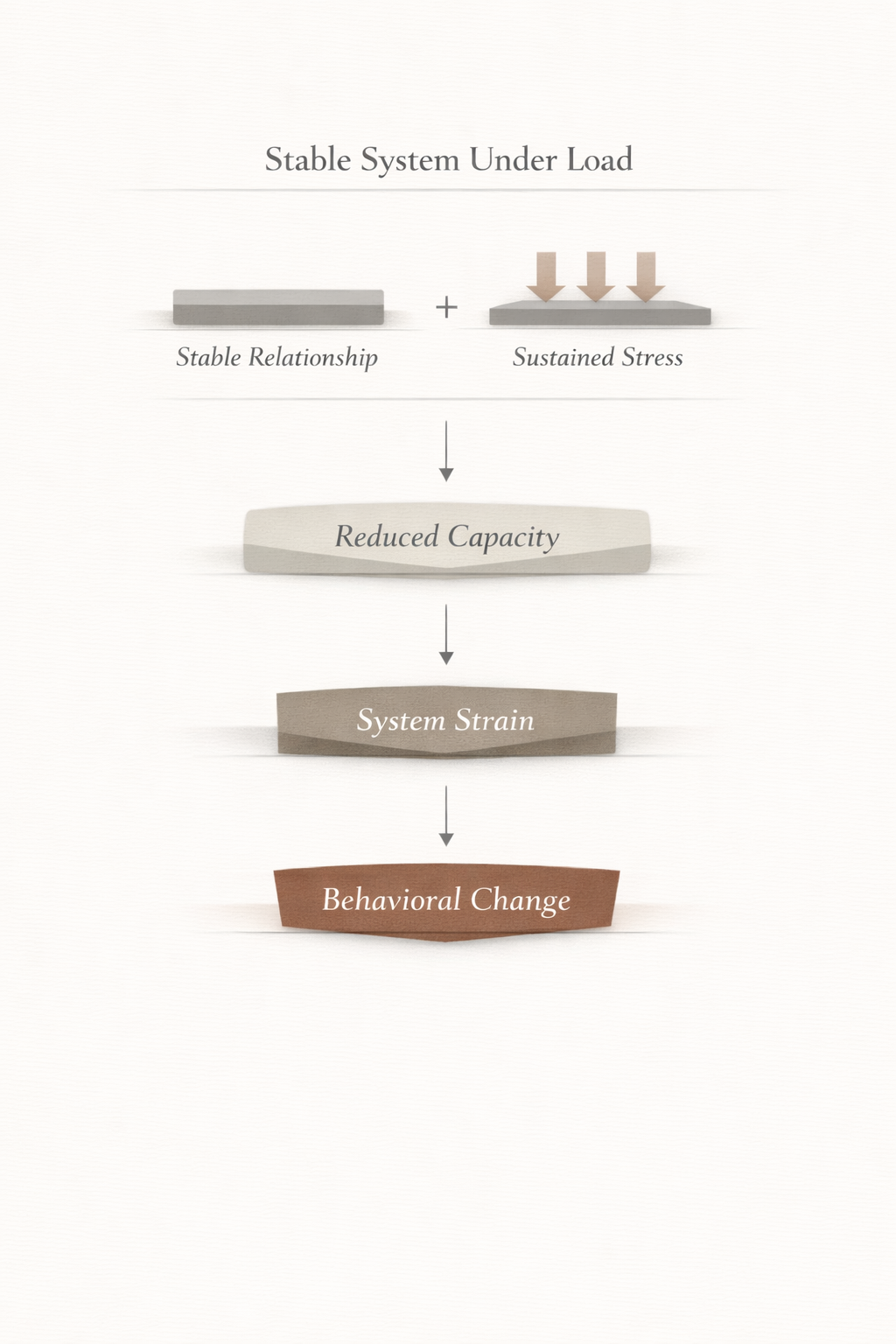
What feels like a relationship breakdown is often a stable system under sustained stress losing its ability to regulate itself. A long-term partnership is more than two people; it is a relational system with its own capacity, its own thresholds, and its own predictable responses to load. For years, that system functions reliably, absorbing the ordinary pressures of life, work, and family. It has a high tolerance for stress, built over time. It is resilient.
But that capacity is not infinite. Midlife transition often introduces a period of sustained, cumulative overload. Hormonal fluctuation is a significant tax on the body’s resources, narrowing emotional bandwidth. Simultaneously, external pressures may increase: career demands peak, aging parents require more care, financial anxieties mount. The system that was built to handle acute stress is now subjected to chronic load from multiple sources, often for years at a time. It begins to operate in a state of persistent resource depletion. This is not a sign of breakdown. It is a sign of overload.
System Capacity vs. Relational Connection
It is crucial to distinguish between the relational connection — the history, love, and commitment between two people — and the functional capacity of the system they inhabit. The connection can remain intact while the system’s ability to function deteriorates. The desire to connect is still present, but the energy required for warm, generous, flexible interaction is not. The system defaults to its most energy-efficient settings: transactional communication, reduced initiation, and a general pulling back from non-essential engagement. People inside this experience it as a loss of feeling, but it is more accurately described as a loss of function. The wiring is still there. The circuit is overloaded.
Pattern Development
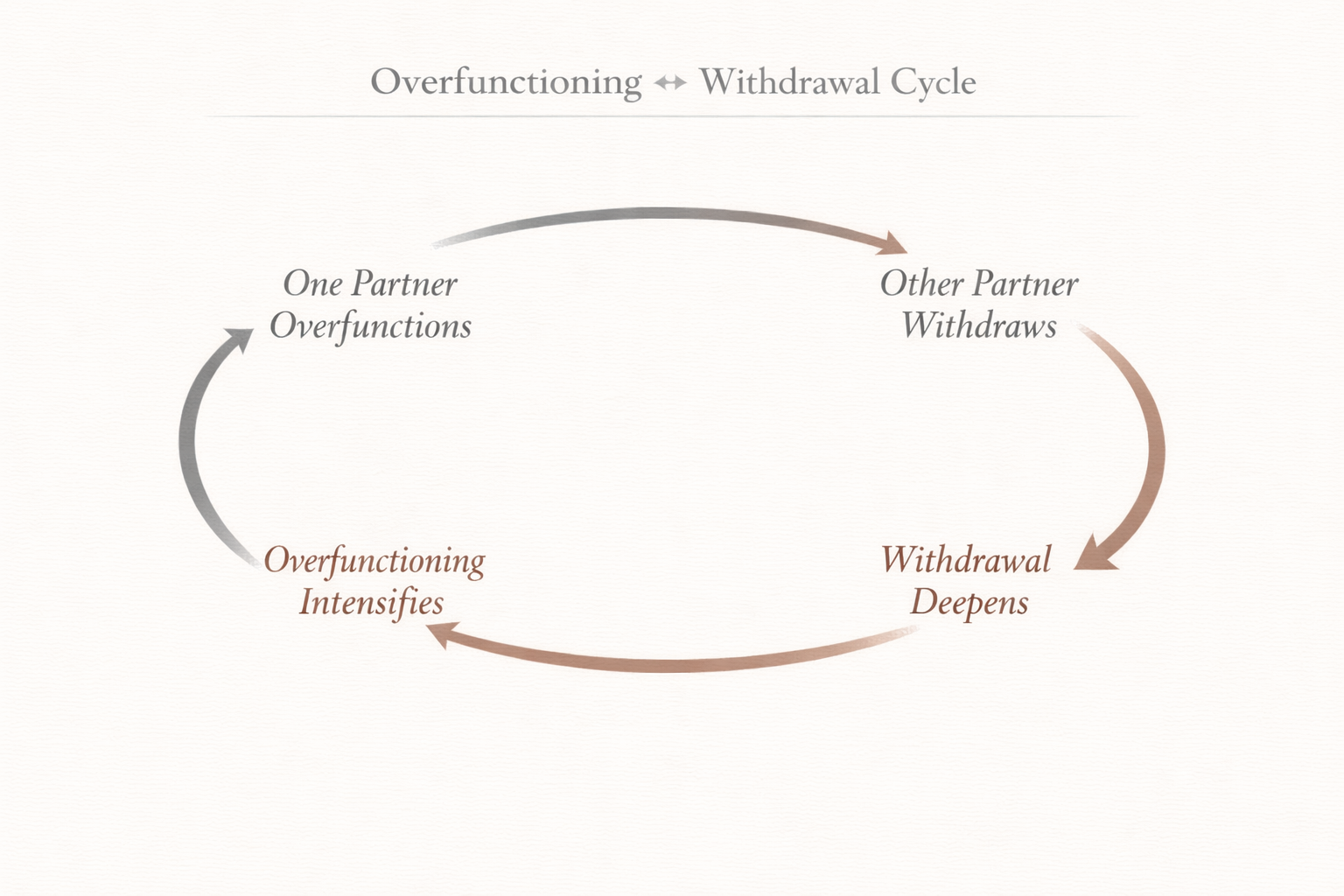
The behavioral changes that emerge from a depleted system are predictable. Because relational warmth requires significant energy, interactions become shorter, more logistical. The focus narrows to the management of the household. The unspoken goal is no longer connection, but a reduction of friction. This is a system trying to conserve its last reserves.
In this state, a complementary pattern often develops. One partner, sensing the growing distance, begins to overfunction — taking on more of the logistical and emotional labor to keep the system stable. They plan the social events, they track the appointments, they monitor the emotional temperature. They bring home a favorite takeout meal, not as an act of spontaneous affection, but as a strategic attempt to inject a moment of ease into a tense environment. The other partner, feeling the pressure of this managerial energy and dealing with their own depletion, withdraws. This withdrawal is not a rejection, but a retreat. It is an attempt to get to ground. The result is a reinforcing loop: the more one person manages, the more the other recedes, and the more the distance between them is codified into their daily structure.
Why Traditional Advice Often Fails
The standard canon of relationship advice is built on an assumption of available capacity. It presumes that both individuals have the emotional, cognitive, and physical resources to learn and implement new behaviors. This assumption collapses in a system running on empty.
Asking a couple in a state of systemic overload to “practice active listening” or “schedule a weekly date night” is often counterproductive. These are optimization strategies. A system under chronic load does not need optimization; it needs stabilization. The directive to communicate with more skill and vulnerability requires the very resources the system lacks. When the attempt inevitably falls flat — when the date night feels like another chore and the carefully constructed conversation goes nowhere — it reinforces the couple’s belief that they are the problem. The advice did not work, so they must be broken. It adds a layer of failure to an already exhausting experience.
The Experience of Failed Advice
For the people involved, this is profoundly demoralizing. They read the books, they listen to the podcasts, they try the techniques. They sit down to have the conversation they are “supposed” to have. But the emotional bandwidth is not there. The attempt feels forced, artificial. One person’s bid for connection is met with a tired, flat response, which is read as disinterest. Resentment builds on both sides. The person trying feels rebuffed; the person who cannot summon the energy feels pressured and misunderstood. They are not failing to communicate. They are trying to run a complex software program on a machine with no available memory.
Stabilization and Reframe
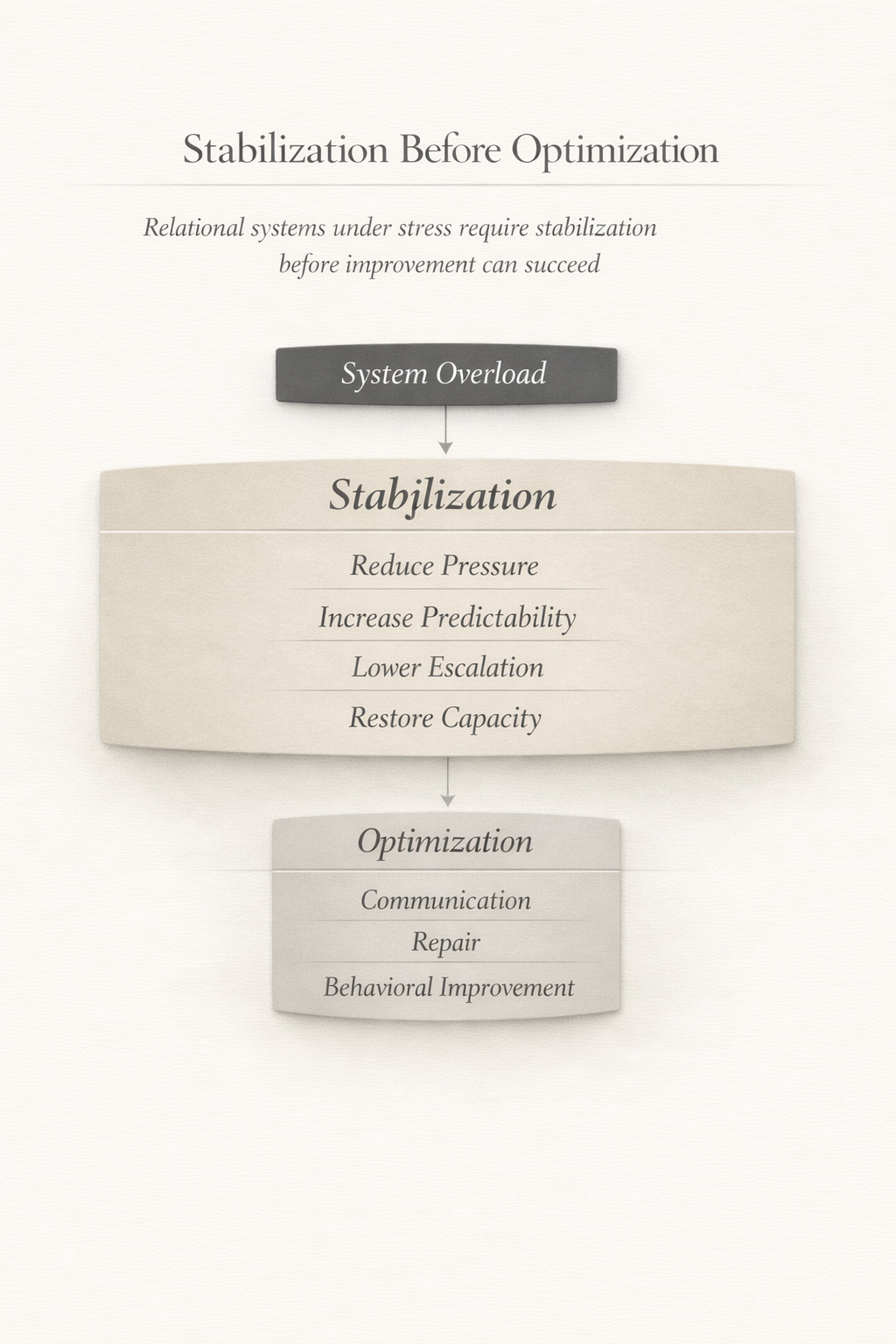
To see this dynamic clearly is to change the nature of the problem. This is not a communication failure. It is a capacity problem. This reframe shifts the primary question away from how do we talk to each other better and toward what does our system need to regain stability?
Stabilization precedes optimization. Before the relationship can be improved, the relentless drain on its resources has to be addressed. This does not mean solving every external problem. It means recognizing the state of overload and making conscious decisions to reduce the system’s overall load. It might mean lowering expectations for a period, reducing social commitments, or simplifying household logistics. The goal is not to fix the relationship. The goal is to create enough slack in the system for its natural regulatory functions to come back online.
This reframe moves the problem from the character of the individuals to the condition of the system. It is a less personal, less shame-inducing diagnosis. It makes the situation no less difficult, but it makes it more coherent.
Closing Reflection
An explanation is not a cure. Understanding that a relationship is operating under systemic duress does not make the quiet in the kitchen feel any less lonely. It does not restore the depleted reserves or erase the memory of a hundred small, distant interactions that have accumulated over months or years. The exhaustion remains real. For a time, the knowledge of the cause and the experience of the effect exist on two separate tracks.
There is a gap between recognizing the pattern and changing it. The pattern has its own momentum. What a systemic understanding offers is not a solution, but a different lens. It stops the search for a villain. It replaces the story of personal failure with one of systemic load. It is possible for a relationship to be both stable and empty, at least for a while.
Misreading a system problem as a moral failing produces one kind of response. Recognizing it for what it is produces another. Neither guarantees a specific outcome, but only one offers a viable place to start.