
Opening Recognition
There is a particular kind of exhaustion that does not show up in a blood panel or a sleep study. It accumulates in the space between conversations — in the moment after something is said, when the response that comes feels slightly off, slightly distant, slightly not quite right. A question about the weekend hangs in the air a second too long. The reply, when it comes, is functional. Yes, that sounds fine. But the energy that used to accompany such a simple act of planning is absent. It is like listening to a recording of a familiar song with one of the instruments missing.
Both people notice. Neither can quite explain it. He wonders if she is upset about something he did. She wonders why he feels so far away. Both are trying. And yet the distance persists, quiet and widening, in a relationship that was not supposed to feel this way. This is one of the more common experiences of midlife relational transition. It is also one of the least named.
The Common Assumption
The standard interpretation of this experience locates the problem in the connection itself. The narrative is a familiar one: we are growing apart. The feelings are fading. We have lost our spark. From this view, the subtle, accumulating signs of distance are treated as evidence of relational decay or a failure of affection. The problem is diagnosed as a deficit of love, interest, or effort.
This assumption leads to a specific kind of internal accounting. One partner might start tracking instances of withdrawal, interpreting them as proof of disinterest. The other might feel a growing sense of pressure, a silent demand for a level of engagement they can no longer access. Each interaction is scrutinized for what it says about the state of the union. The problem is personal. It is about us.
The Hidden System Dynamic
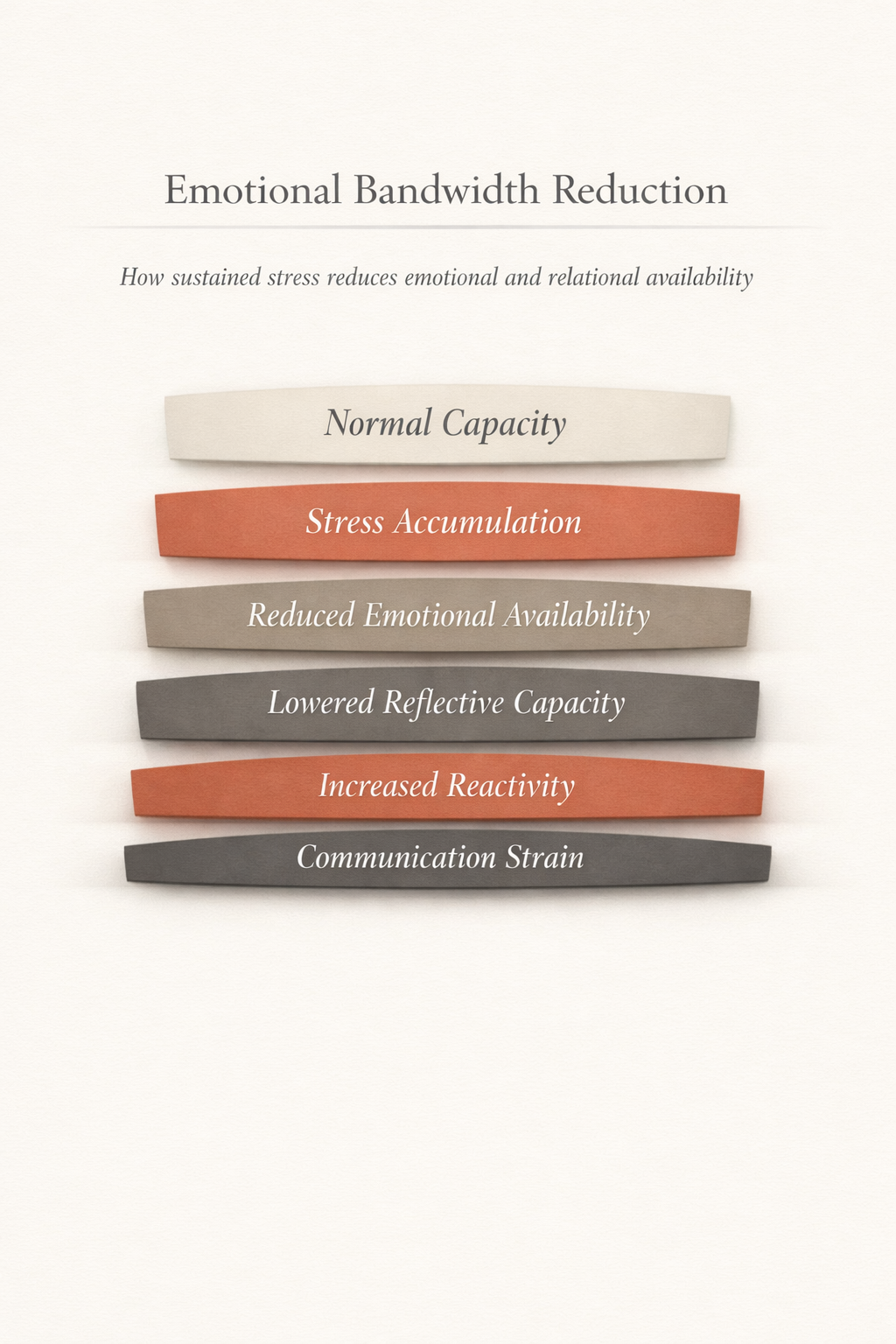
What looks like a communication problem is often something more structural. A relationship is not just two individuals; it is a relational system. And like any system, it has a finite capacity to manage stress, process information, and produce functional interaction. When that system is operating under sustained stress — from career pressure, financial worries, aging parents, the hormonal shifts of midlife — its capacity begins to contract.
This is the dynamic of Relational System Stress. It is not a crisis or a rupture, but a slow, quiet depletion of the system’s resources. A key resource that depletes is Emotional Bandwidth — the available capacity a person has to process relational and emotional demands. As bandwidth narrows, the system’s ability to self-regulate diminishes. Reactive thresholds lower. The margin for misreading increases. Most people living inside this do not experience it as a system problem. They experience it as a character problem — their own, or their partner's.
The Contraction of Capacity
What feels like personal withdrawal is often a systemic contraction. The relational system, overloaded, begins to run on a kind of low-power mode. It preserves core functions — logistics, co-parenting, household management — while shedding processes that require more energy. This includes spontaneity, unstructured conversation, deep listening, and physical affection that is not routine. The system is not breaking down. It is protecting itself. This contraction is not a conscious choice made by either person. It is a predictable, physiological response of a system running on reduced resources. It is quiet and strange.Pattern Development
The pattern often begins with a change in the texture of daily life. The easy humor that once filled the kitchen during dinner preparation is replaced by a more functional silence. Conversations that used to meander now drive toward a point. One partner might notice this first, feeling the absence of a shared ease. They might attempt to restore it, to draw the other person out.
Here, a second concrete moment often occurs. He comes home with an idea for a weekend trip, something they used to love doing. He presents it with a tentative optimism. She is in the middle of reviewing a work email and balancing the budget, and the invitation lands not as a gift, but as another task requiring energy she does not have. Her response is flat. “I don’t know. I’m just so tired.” He hears rejection. She feels a familiar pang of being misunderstood, of being asked for one more thing. The attempt to connect creates more distance.
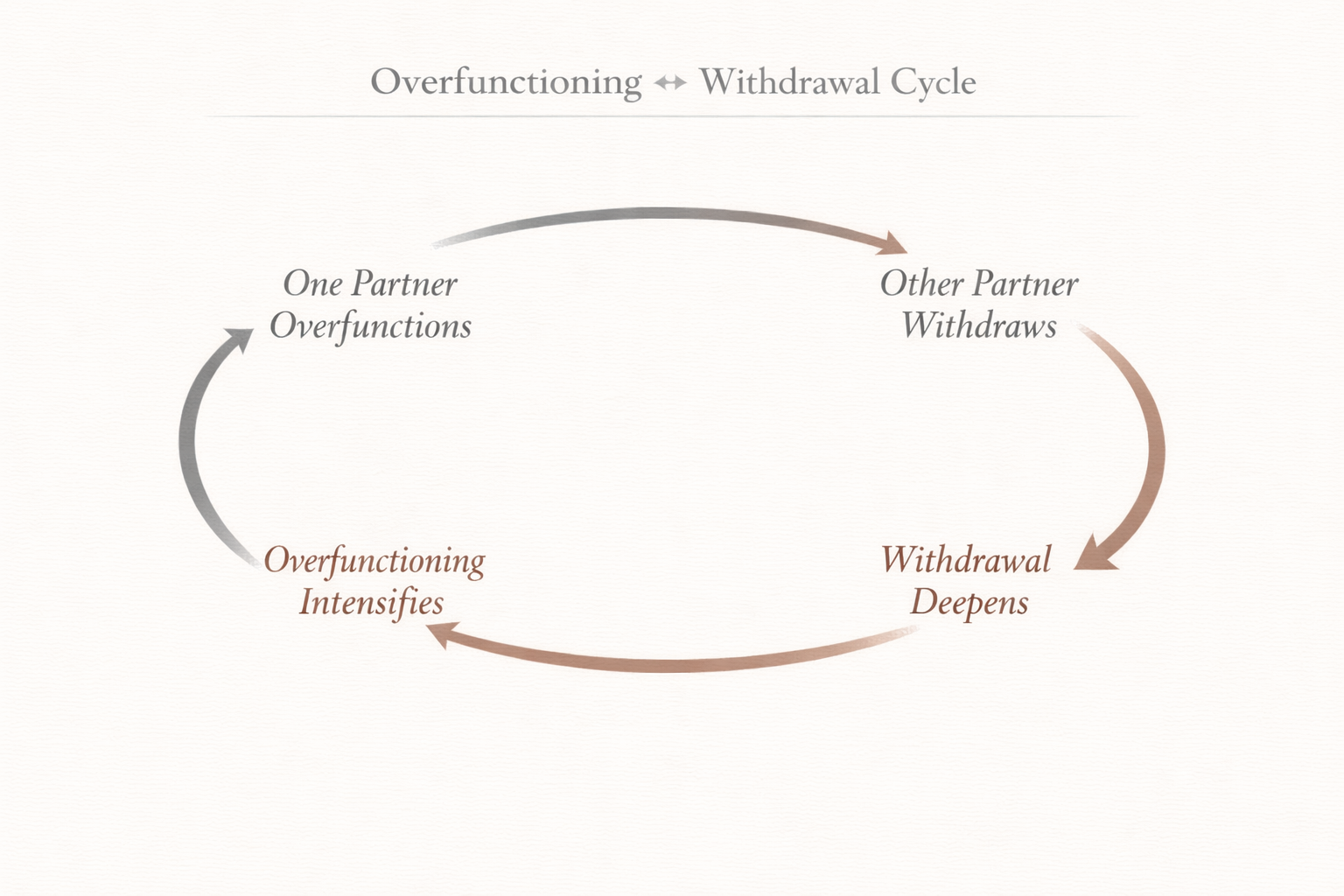
This can initiate a complementary pattern of Overfunctioning and Withdrawal. One partner escalates their efforts, trying to manage the relationship back to health, while the other retreats further, overwhelmed by the increased demand for engagement. This is not a conscious strategy. It is what happens when one person interprets system stress as a problem to be solved and the other experiences that attempt as an additional load on an already overloaded circuit.
Why Traditional Advice Often Fails
Under these conditions, standard relational advice will consistently underperform. Suggestions to “plan a date night” or “schedule time to talk” are built on the assumption that the system has the available Emotional Bandwidth to use those tools effectively. But when a system is in a state of overload, these well-intentioned strategies can become another source of pressure.
Misdiagnosing a system problem as a personal failure ensures that every attempted solution will feel like another form of blame. The advice itself is not wrong. The conditions it requires simply do not exist. Telling a couple experiencing Relational System Stress to communicate more openly is not unlike asking an overloaded computer to run another complex application. The command is logical. The system lacks the processing power to execute it.
The Problem of Pre-requisites
The core issue is one of sequencing. Optimization strategies, like improving communication skills, require a baseline of systemic stability. When that stability is absent, the strategies fail, reinforcing the couple’s belief that their relationship is the problem. A date night, meant to be restorative, can feel like a performance for two exhausted people. A scheduled conversation can feel like a tribunal. The prescription adds another load, increasing the very stress it is meant to alleviate. This is a critical reason why so many couples report feeling stuck; they are applying workable solutions under unworkable conditions.Stabilization and Reframe
The most useful shift in this situation is not behavioral, but conceptual. It is a reframe of the problem itself. This is not a relationship breakdown. It is a stable system under sustained stress losing its ability to regulate itself. The signs of distance, flatness, and withdrawal are not evidence of a failing connection. They are signals that the system's total load has exceeded its capacity.
This reframe does not make the situation easier. It does not produce a cleaner path forward or reduce the frustration of repeated conversations that resolve nothing. What it changes is the question being asked. Not “How do we fix us?” but “What is loading our system, and what would stabilization require?” The focus shifts from moral inventory to system diagnostics. From who is failing to what is overloaded. This changes the locus of the problem from character to context.
Closing Reflection
Understanding the system does not immediately change it. Recognizing that a relationship is under structural stress rather than behavioral failure does not dissolve the exhaustion, repair the distance, or restore what has been quietly depleted over a long stretch of time. The flatness might still be there in the morning. What it can do is alter the frame through which the experience is interpreted.
The weight of believing your relationship is failing is a heavy one. It adds a secondary layer of anxiety and grief to the primary experience of depletion. Naming the dynamic as a system under load may not lessen the load, but it can remove the weight of misinterpretation. The exhaustion remains. A correct diagnosis does not guarantee a cure, only a different set of questions.