
Opening Recognition
Many women notice changes in their appearance when looking in a mirror, often late at night or in bright morning light. The external appearance is familiar. The lines around the eyes are logged and accounted for. But the person looking back is a stranger. The internal sense of self — that quiet, consistent hum of being that has been present for decades — has gone quiet. Or perhaps it is not quiet, but is broadcasting on a frequency you no longer recognize.
This experience of internal unfamiliarity often surfaces in relational moments. Your partner tells a story about you from ten years ago, a story you have both told many times, but tonight it sounds like a biography of someone else. They say, with affection, “You always get so quiet at big parties.” And the thought that forms, unbidden, is, I am not that person anymore. I do not know who I am at parties now. The observation is not wrong. It is simply out of date. The distance this creates is palpable, even if only one of you can feel it.
The Common Assumption
When this internal shift becomes undeniable, the most common interpretation is that something is wrong. That this is a deficit. A loss of self, a loss of joy, a midlife slump. The assumption is that the person you once were is the correct and permanent version, and this new, uncertain self is a temporary deviation. A problem to be solved.
From this assumption flows a predictable set of responses. The attempt to “find yourself again” by resurrecting old hobbies. The decision to push through the discomfort, to perform the role of the person you used to be in the hope that the feeling will follow. The narrative is one of loss and recovery. The goal is restoration. This is a normal response to disorientation. It is also often a misdiagnosis of the event.
The Hidden System Dynamic
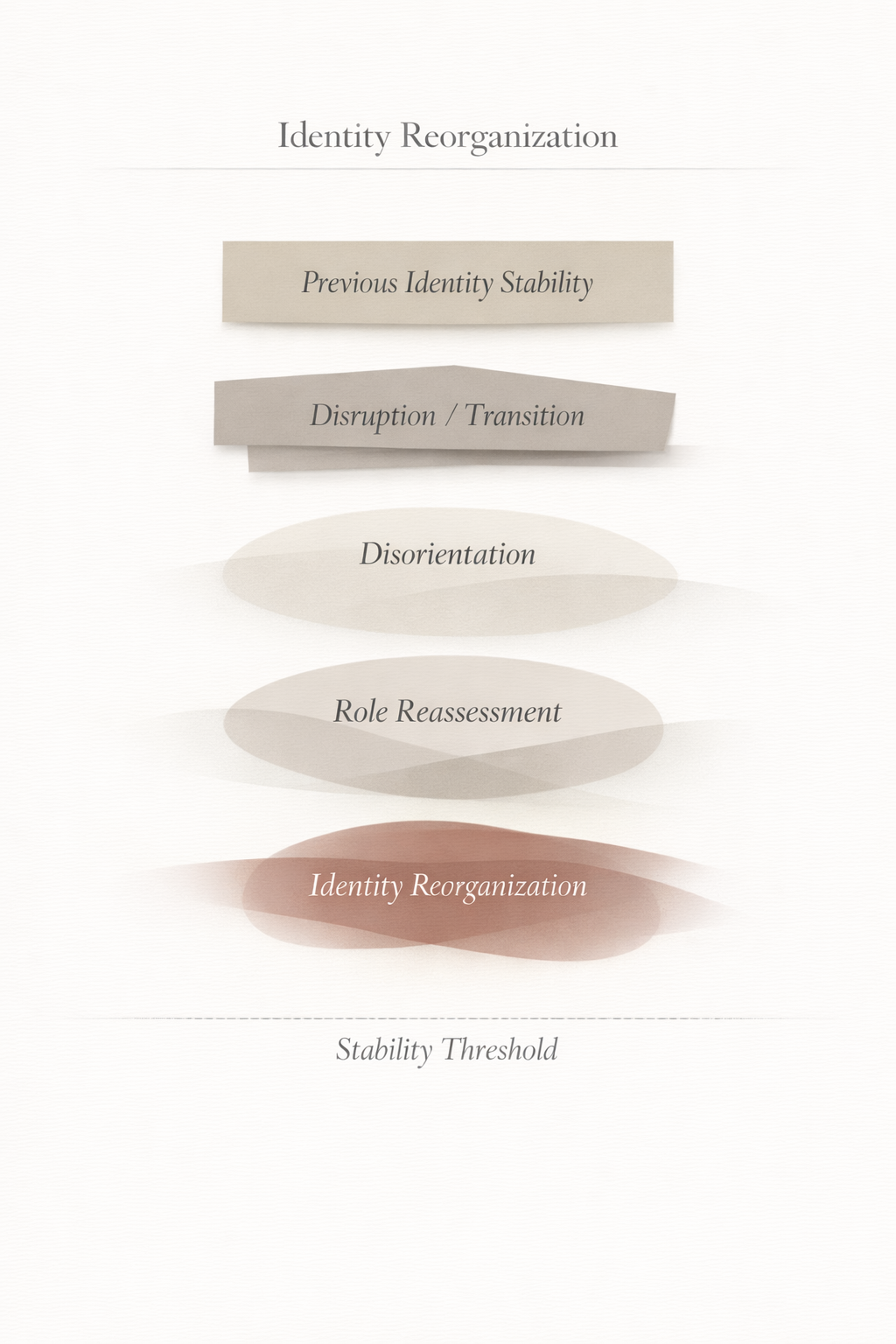
What is often experienced as a loss of self is better understood as a fundamental reorganization of identity. This is not a temporary phase to be fixed or optimized. It is a structural process in which the component parts of identity — roles, values, beliefs, and personal narratives — are disassembled and re-evaluated. It is less like losing a map and more like the landscape itself changing.
Midlife, particularly the hormonal transition of perimenopause and menopause, is a common catalyst for this process. The physiological changes are not separate from the psychological ones. They can alter the very foundation of how a person experiences their body, their energy, their desires, and their tolerance for things they once accepted without question. The identity that was constructed in and for a different biochemical and life-stage reality may no longer fit. It is not a failure. It is a functional recalibration.
The Collapse of Old Scaffolding
Much of adult identity is built around a scaffolding of external roles: the professional, the parent, the partner, the caretaker. This scaffolding is useful and necessary. It provides structure and a sense of purpose. During midlife transition, that scaffolding often begins to weaken or dissolve. Children leave home, careers plateau or shift, parental health declines, and the body itself asserts a new set of terms. When the roles that once defined the self become less central, the question of who you are without them becomes unavoidable. This is not a crisis in the popular sense of the word. It is a confrontation with the core architecture of the self, now visible because the exterior cladding has been removed.
Pattern Development
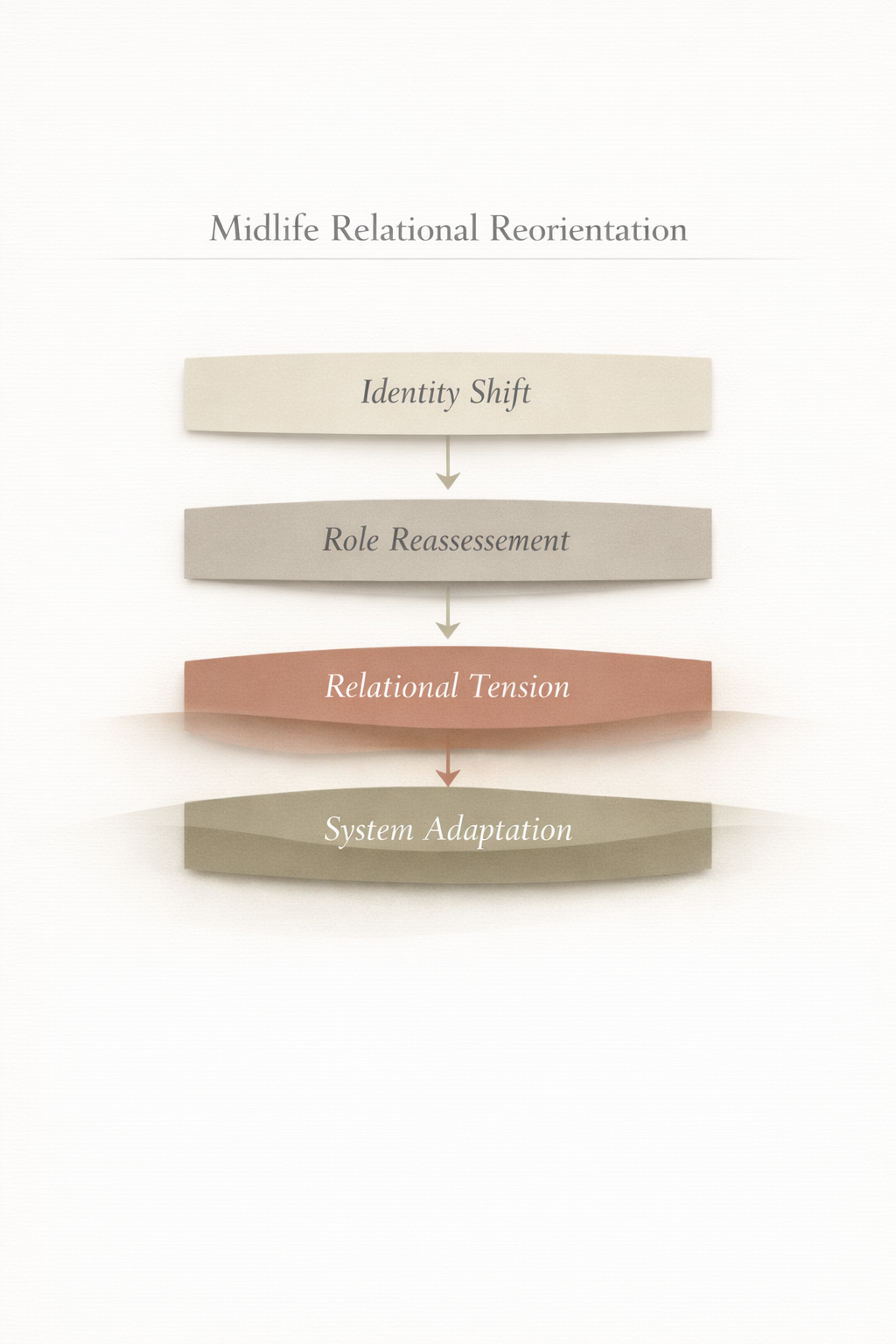
This internal reorganization inevitably alters the relational system. A relationship is, in part, a set of agreements, spoken and unspoken, between two established identities. When one of those identities begins to change from the inside out, the agreements are stressed. The pattern is predictable. One person begins to quietly deviate from their established role — not in a dramatic rupture, but in small, cumulative ways. Saying no to a social event they would have previously endured. No longer having the capacity to absorb another person’s anxiety. Responding with silence where an opinion was once expected.
To the partner, this can feel like withdrawal or rejection. They are interacting with the person they have always known, using a relational map that has worked for years. When the expected response does not come, it is often interpreted as a behavioral problem — “You seem angry,” or “You’re so distant lately.” The person experiencing the identity shift often has no better explanation. They cannot articulate what is changing because they are in the middle of it. The result is a conversation where both people are describing a real experience, but they are talking about different things. They are not connecting. The old way does not work anymore.
The Experience of Being Misread
For the person undergoing this reorganization, one of the most exhausting parts of the process is the constant, low-grade experience of being misread. Your partner tries to cheer you up by planning an activity that the “old you” would have loved, and the effort itself feels like a weight. They are trying to connect with a person who is no longer fully present. Every interaction based on the old template reinforces the feeling of alienation — from your partner, and from yourself. It is a particular kind of loneliness to be in a room with someone who knows you intimately but is speaking to a ghost.
Why Traditional Advice Often Fails
Advice in this context tends to focus on action. “Schedule date nights.” “Talk more.” “Find a shared hobby.” This advice presumes the problem is a lack of connection or a failure of communication. It assumes the underlying structures of self are stable and simply need to be accessed more effectively. But when the problem is not a behavioral gap but a structural identity shift, these solutions miss the point entirely.
Asking someone who is in the midst of a profound internal reorganization to “be more present” or “try harder” to connect is like asking a house to be more stable while its foundations are being reset. The request is logical, but the conditions make it impossible. In fact, attempting to follow such advice can increase the sense of failure and isolation. The effort to perform a version of yourself you no longer inhabit depletes the capacity needed for the real, necessary work of figuring out who you are becoming, making it harder to address the Relational System Stress that contributes to Invisible Relational Load, Overfunctioning and Withdrawal, and the critical need for Stabilization Before Optimization.
Stabilization and Reframe
The most useful shift in perspective is to move from a frame of fixing to a frame of observation. This is not a problem to be solved. It is a process to be endured and, eventually, understood. The central reframe is this: what is happening is not a midlife crisis, but a midlife identity reorganization. The former implies a temporary, regrettable madness. The latter names it as a developmental, structural, and necessary process.
Stabilization, then, is not about finding the answers. It is about lowering the pressure to have them. For a relational system, this means replacing the question, “How do we get back to how we were?” with a different one: “What is true right now?” It means allowing for the uncertainty. It means creating space for a new self to emerge, without demanding it look or feel like the old one. This does not resolve the tension. It changes its character from a problem to be solved into a condition to be navigated.
Closing Reflection
Understanding that you are in a process of reorganization does not make the disorientation go away. The knowledge that the landscape is changing does not provide a new map, at least not at first. There is a period of living in the space between, of being both the person you were and the person you are not yet. It is a period characterized by a quiet and persistent sense of being out of place, even at home.
This is not a failure of character or a lack of gratitude for the life one has built. It is simply a sign that the architecture that held one stage of life is no longer sufficient for the next. Recognizing the process does not dictate its outcome. It only provides a more accurate name for the groundlessness, which is not a solution, but is not nothing.