
Opening Recognition
There is a specific kind of dissonance that settles in during midlife. It can surface in a quiet moment, looking at a photograph of yourself from ten years ago and feeling a sense of polite confusion, as if looking at a distant relative one is supposed to remember but cannot quite place. The recognition is there — the face, the event — but the internal state of that person has become inaccessible. It is a closed file.
A friend mentions a project you once poured years into, speaking of your old drive with admiration. “You were so passionate about that,” they say, and the words land without resonance. It sounds like a story about someone else. The memory is accurate, but the feeling that animated it is gone, replaced not by sadness or regret, but by a kind of flat neutrality. There is no charge left on the wire. This absence feels more profound than a simple change of interest. It feels like a subtraction of self.
The Common Assumption
When this experience is recognized at all, it is typically interpreted as a problem. It is framed as burnout, ennui, or a loss of direction. The common assumption is that a previous, more vibrant self has been misplaced and must be recovered. The internal and external narrative becomes one of finding what was lost. Friends and family might encourage new hobbies, travel, or a career change — all in an effort to “get the old you back.”
The person experiencing it often agrees with this diagnosis. They chide themselves for a lack of motivation or gratitude. They try to reignite old passions or force new ones, believing that the right amount of effort or the right new stimulus will reset them to their prior factory settings. This is a reasonable assumption. It is also the source of significant, unnecessary distress, because it mistakes the nature of what is happening.
The Hidden System Dynamic
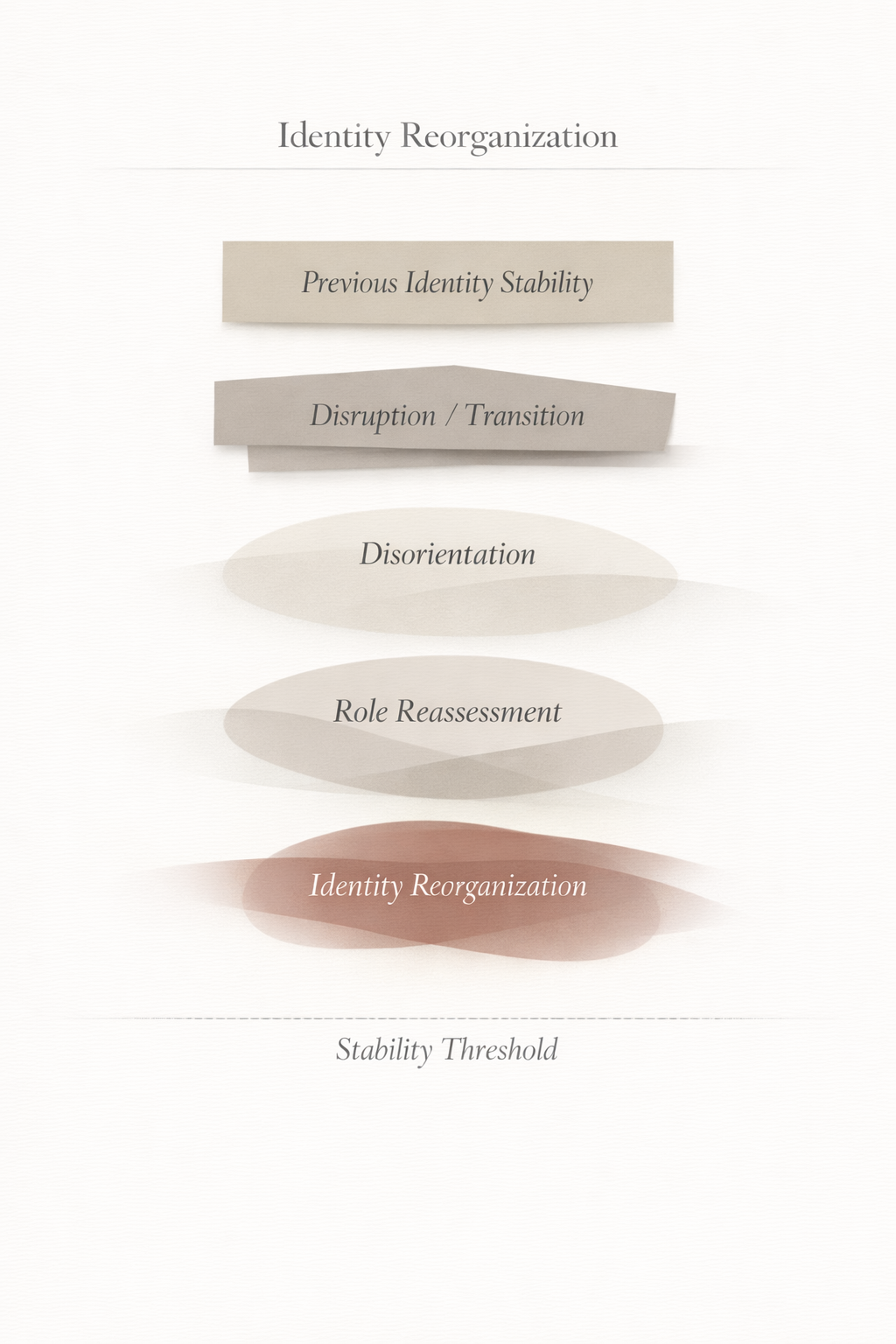
The disorientation and grief are not for a lost self, but for a coherent self. Identity is not a static object one possesses, but a dynamic system that continuously organizes perception, motivation, and behavior. It maintains a state of relative consistency by balancing internal biological realities with external roles, relationships, and responsibilities. Midlife, and the hormonal transition that often accompanies it, is a systemic shock to this organizing process.
What feels like a personal failing — a loss of interest, a change in personality — is the system's response to a fundamental shift in its operating conditions. The biological and neurological underpinnings that supported a previous version of identity have changed. Continuing to run the old “software” of ambition, social patterns, and relational expectations on the new “hardware” becomes inefficient and exhausting. The system begins to shed non-essential processes to conserve energy for a deep, internal reorganization.
Identity as an Operating System
Thinking of identity as an operating system can be a useful frame. For decades, it ran smoothly, supporting various applications: career ambition, specific social roles, parenting models, modes of partnership. The user became accustomed to its speed and function. The hormonal shifts of perimenopause and menopause are not just a minor patch; they are a full hardware upgrade that requires a new operating system. The feeling of being “not oneself” is the lag time, the incompatibility errors, the system slowdown as the new OS installs. The grief is real, but it is for the functional simplicity of the old, familiar system. What is often mistaken for a loss of self is better understood as a reorganization of identity.
Pattern Development
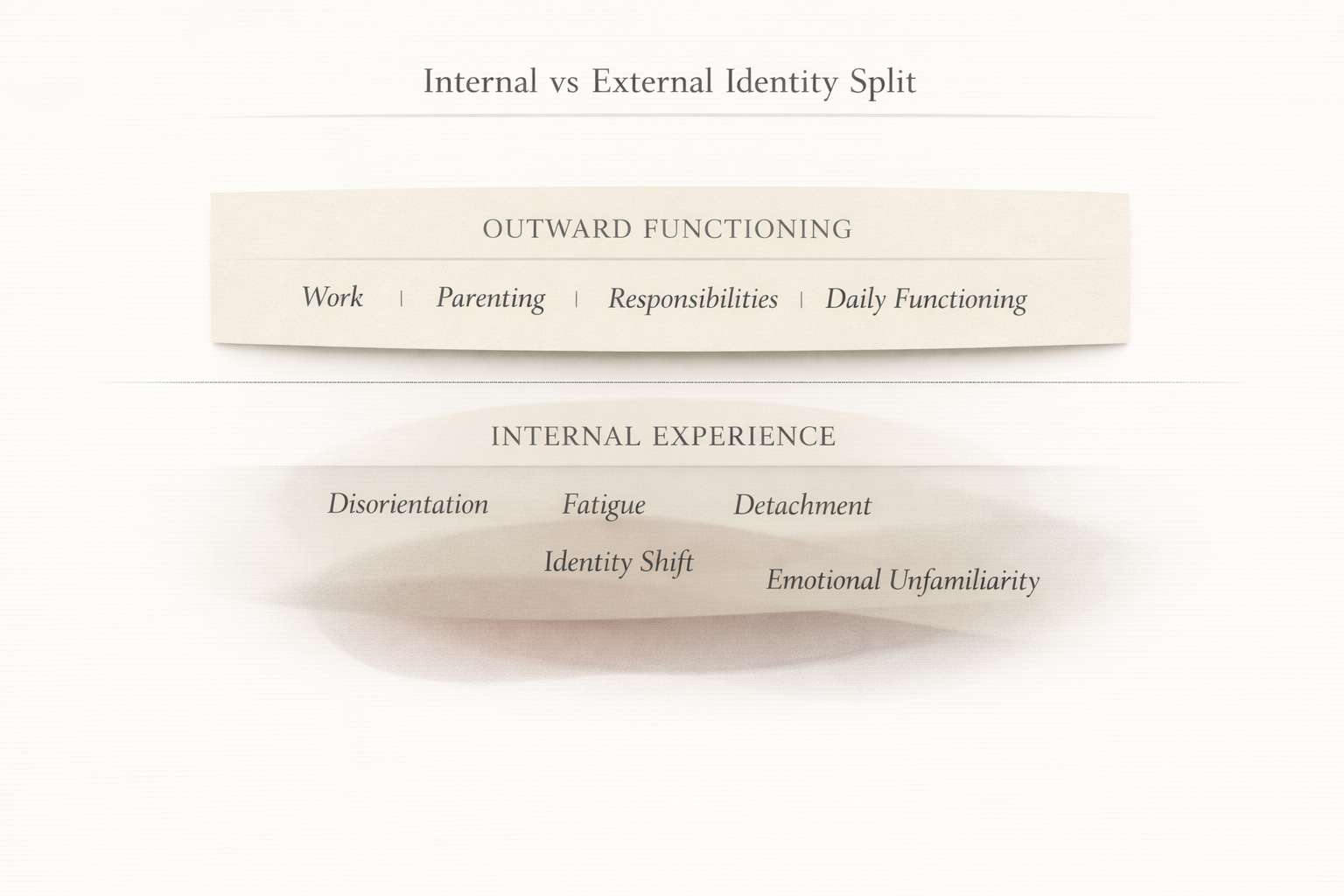
The pattern unfolds not in a crash, but through a slow, quiet erosion of the familiar. It shows up in small refusals. A partner asks, “What do you want to do for your birthday this year?” and for the first time, the honest answer is a quiet “I don’t know.” Or even, “Nothing.” This is not the depressed “nothing” of anhedonia, but a genuine absence of the energetic capacity required for wanting, planning, and performing celebration. To the person saying it, it feels true. To the partner hearing it, it can feel like a withdrawal of affection or engagement.
Attempts to override this state by performing the expected identity—planning the party, manufacturing enthusiasm—feel hollow and lead to a particular kind of exhaustion. This creates a feedback loop: the self that is presented to the world feels increasingly fraudulent, while the authentic internal state feels illegitimate and socially unacceptable. Maybe I am just tired. Or maybe this is who I am now. But if this is who I am, I do not know how to be this person. Yet I was tired of being the old one, too. The question of who to be becomes a constant, low-grade hum of unresolved static.
Why Traditional Advice Often Fails
This is why so much well-intentioned advice underperforms. Prescriptions to “find your passion,” “reinvent yourself,” or “make a bucket list” are designed for a system that is ready to add new functions. They are based on an expansionist model of self-development. But the system in the midst of reorganization is not in an expansionist phase. It is in a consolidation phase. It is not ready to add; it is busy trying to figure out what is still essential.
Asking someone in this state to find a new passion is like asking a company that is undergoing a deep structural merger to also launch a new product line. The capacity is simply not there. The request, however reasonable it sounds, ignores the state of the underlying system. When the advice inevitably fails to produce the desired result, the experience is not one of having received bad advice, but of being a bad student. It reinforces the sense of personal failure.
The Failure of Additive Solutions
Most conventional self-help models are additive. They propose that fulfillment is achieved by adding skills, experiences, or mindsets. This framework is not wrong, but it is context-dependent. It works when the core identity structure is stable. When that structure is itself the variable, additive solutions become another source of pressure on an already overloaded system. The work is not to add, but to allow for subtraction. It is to create enough space for the reorganization to complete its process without constant interruption from the demand to be someone, to want something, to be going somewhere.
Stabilization and Reframe
This is not a phase to fix or optimize. It is a reorganization of identity that changes how a person experiences themselves and their relationships. The reframe moves from a position of fixing a deficit to one of observing a process. The primary task is not to rebuild the old self or to architect a new one from scratch, but to stabilize the system so the reorganization can unfold with less friction.
Stabilization, in this context, often means subtracting, not adding. It means giving oneself permission for the “I don’t know.” It means lowering the demand to have a five-year plan, a clear sense of purpose, or a consistent social personality. It requires tolerating a period of ambiguity. It means trusting that the quiet, the emptiness, and the disinterest are not the final destination but part of the transit. The person you were is not the person you are.
Closing Reflection
Understanding this process does not make the grief disappear. Acknowledging the reality of a systemic reorganization does not instantly create a new, coherent identity to inhabit. The disorientation remains a real and present feature of the experience, and the sense of loss for a past self that felt knowable and solid is not imaginary.
What the reframe offers is not a solution, but a different quality of attention. It replaces the question, “How do I fix this and get back to who I was?” with a quieter, more spacious one: “What is happening here, and what is emerging?” The first question creates a cycle of effort and failure. The second allows for the possibility that this state, as uncomfortable as it is, is not a final failure but a necessary transition. There is no map for what comes next.