
Opening Recognition
He asks about her day from the driver’s seat, and the answer she gives is correct but also completely empty. A few facts. No texture. He waits for more, but nothing comes. The silence that follows is not a comfortable one. It feels heavy, like an object in the car with them. Later, she is unloading the dishwasher with a sharp, contained energy, and he walks into the kitchen to ask if they are out of coffee. The look he gets feels disconnected from the question. The response — a clipped, “I don’t know, I haven’t looked” — lands with the force of an accusation. In the quiet that follows, both are left with the same feeling. A sense of confusion. A sense of being misunderstood, and of misunderstanding. This is not us.
What is this? It feels like something is breaking, but nothing has actually happened. There was no fight. There was no inciting incident. There is only this persistent, low-grade relational static. This is one of the most common, and least legible, experiences of a relational system encountering the biological transition of perimenopause.
The Common Assumption
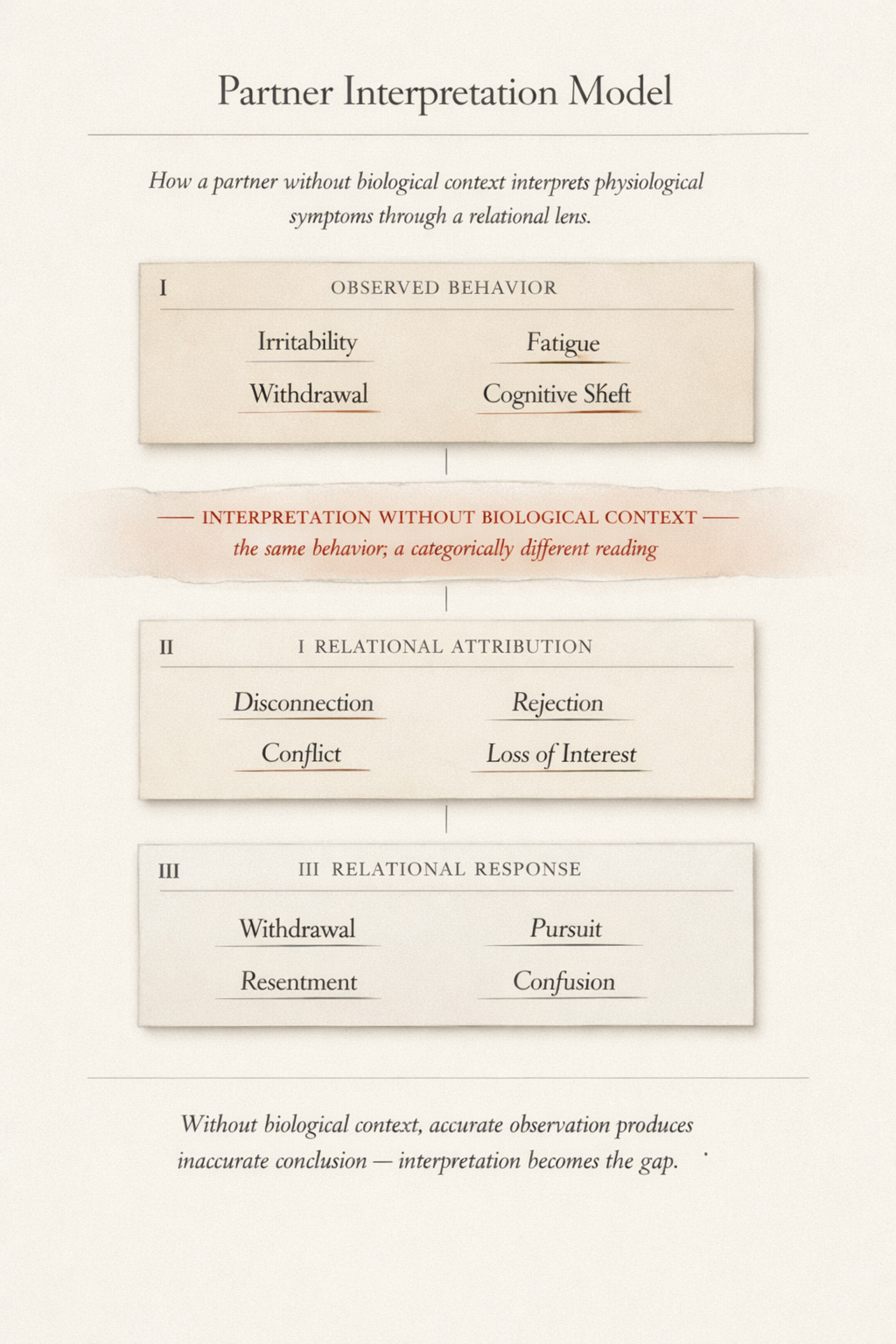
The standard interpretation is that this is a communication problem. Or a connection problem. We are drifting apart. We are not making time for each other. She is angry all the time. He has checked out. Under this assumption, the diagnosis is relational failure, and the prescription is to try harder. To talk more, schedule a date night, read a book about active listening. These are diagnoses of character and behavior. They locate the problem inside the choices people are making.
This interpretation is logical. It is also, for many couples in this specific life stage, an expensive misreading of the situation. It directs effort toward the wrong problem, often depleting what few resources the system has left.
The Hidden System Dynamic
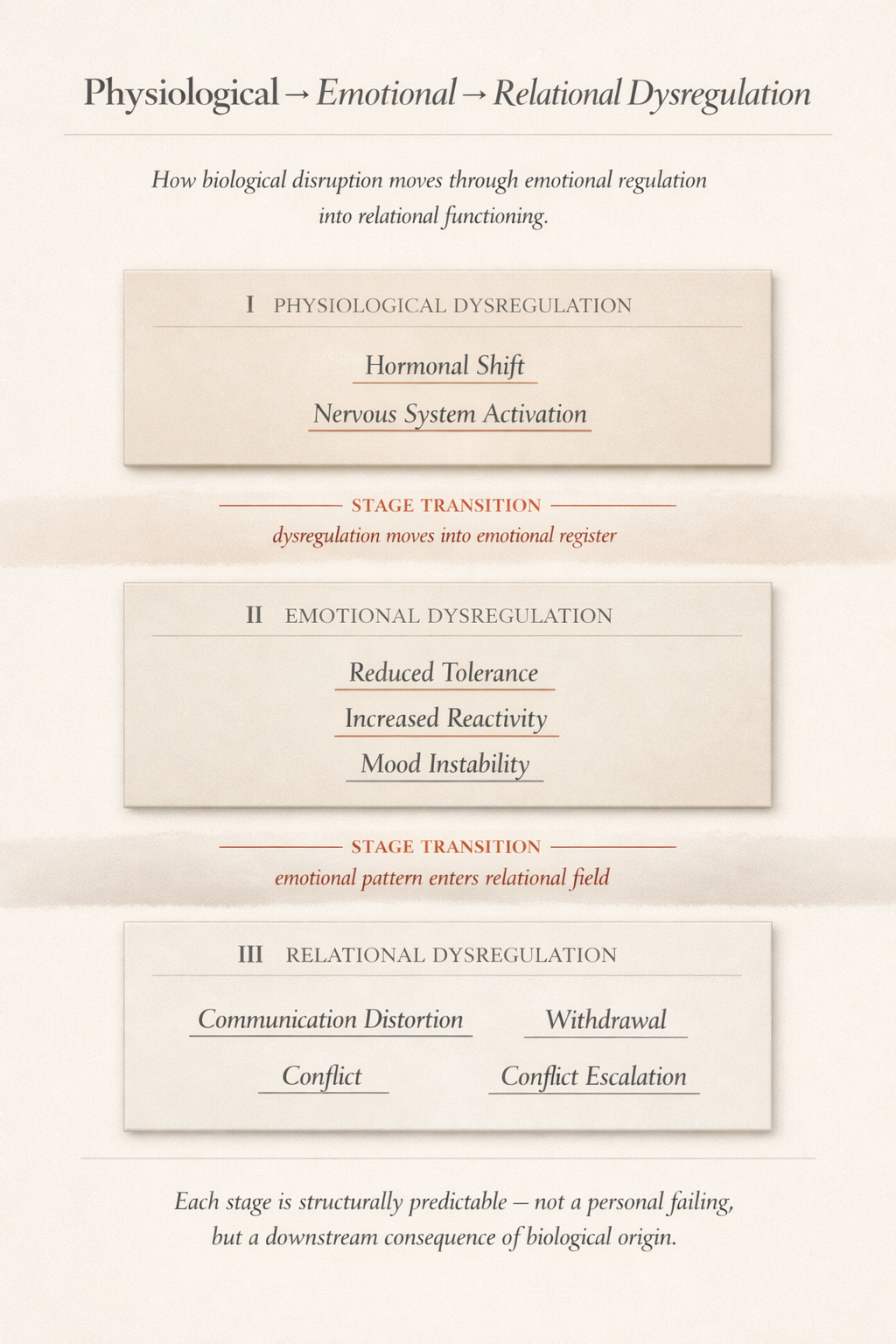
Perimenopause is not a psychological event. It is a biological one with profound psychological and relational consequences. The fluctuating and eventual decline of estrogen and progesterone does not just produce hot flashes or irregular cycles. It remodels the female brain and nervous system. This is not metaphor. It is neurology. For the relational system, this biological event acts as a significant, unnamed stressor.
This is the definition of Relational System Stress: a sustained pressure that exceeds the system’s capacity to regulate itself. The biology is the stressor. A primary effect of this neurological shift is a measurable reduction in what can be called Emotional Bandwidth. This is the finite capacity a person has to process emotional and cognitive input, manage their own responses, and engage with the needs of others. When hormonal infrastructure is in flux, bandwidth contracts. It’s not a choice. It is a functional consequence. The system, which once ran on a full battery, is now operating on low power mode. But no one has changed the settings.
Pattern Development
The system attempts to function as it always has, but with diminished capacity. This is where predictable, destabilizing patterns emerge. One such pattern is the collision between reduced bandwidth and Invisible Relational Load. This is the sum of all the unseen, unspoken work of managing a household and a relationship: tracking the appointments, anticipating the social obligations, monitoring the emotional temperature of the family. A great deal of this labor is carried quietly. When the partner carrying it suddenly has less capacity, things begin to be dropped. Not out of malice or neglect, but out of sheer systemic depletion.
This often triggers a complementary pattern of Overfunctioning and Withdrawal. The depleted partner may withdraw, pulling back from engagement because interaction itself feels too costly. The other partner, feeling the withdrawal and seeing the dropped tasks, may interpret it as a lack of care and either withdraw in response or begin overfunctioning—picking up the slack, managing more, asking more questions, trying to fix the perceived problem. This feels like help, but to the depleted partner, it can be experienced as more demand, more noise, more to manage. The system polarizes. The distance widens. He thinks she does not care. She thinks he does not see how hard this is. They are both right.
Why Traditional Advice Often Fails
This is the point at which most couples seek out familiar advice. Communicate more. Be more vulnerable. Listen with more empathy. This is advice for optimization. But the system is not ready for optimization. It is in a state of instability.
This illustrates a critical sequencing principle: Stabilization Before Optimization. Attempting to run high-level communication protocols on an unstable system is like trying to install new software on a computer with a failing power supply. The request is sound, the hardware cannot execute it. The advice fails not because it is wrong, but because the preconditions for its success—sufficient emotional bandwidth, a regulated nervous system, a shared understanding of the problem—are not in place. The repeated failure of these attempts then becomes another source of stress on the system, confirming the story that the relationship itself is failing.
Stabilization and Reframe
What is often mistaken for a communication failure is better understood as a capacity problem. The central reframe is this: This is not a relationship problem. It is a biological transition that the relational system was never designed to absorb without interpretation.
The work is not, at first, to fix the relationship. The work is to stabilize the system so that the relationship has a place to operate. Stabilization begins with renaming the problem. It is not her irritability or his withdrawal. It is the physiological event of perimenopause introducing massive, unasked-for stress. This externalizes the issue. It is not you against me. It is us, together, looking at this biological process that is acting on our system. Stabilization means radically reducing the load on the system. It can mean lowering expectations for connection, simplifying schedules, letting go of non-essential domestic and social labor, and explicitly acknowledging that the system is running on reduced power. The question shifts from how do we get back to where we were? to what do we need to do to get through this intact? Those are different questions. They do not always lead to the same place.
Closing Reflection
Naming the dynamic does not instantly repair it. This is worth saying plainly. To understand that the system is under biological siege does not restore emotional bandwidth or erase the memory of the clipped response in the kitchen. The exhaustion can remain. The distance can feel just as real. What changes is the story that is told about it. And that is not a small thing.
Misinterpreting a system problem as a character flaw produces one kind of suffering: shame, blame, and a lonely sense of failure. Recognizing it as a shared biological reality allows for another. It is the difference between believing you are the problem and knowing you are in one. This shift does not produce a cleaner path forward. It doesn't dissolve the frustration of a conversation that goes nowhere tonight. Sometimes the clarity is just clarity. It doesn't fix anything.
The relief is not in the solution, but in the diagnosis. It provides a frame that is truer, more compassionate, and ultimately more functional. It allows two people to stop trying to solve each other and instead face the real issue together, however unfamiliar its shape. It is a starting point, not a destination. And recognition of the true problem does not guarantee its resolution.