
Opening Recognition
There is a shift that can happen in a long-term relationship, a change in relational posture that is difficult to name. It often begins quietly. He notices she seems to be carrying something heavy, though she denies it. He starts to watch her in a new way, with a kind of gentle, worried vigilance. He asks if she is alright, and the answer is a clipped, ‘I am fine,’ that feels neither fine nor directed at him. She feels his watching. It feels less like care and more like a demand she cannot meet. She begins to feel managed, and he begins to feel like a caregiver to a person who is not sick.
This is not a fight. It is something quieter and more perplexing. It is the sensation of one partner beginning to orbit the other’s internal state, and the other wishing for nothing more than to be left alone in it. The connection, once fluid and assumed, now feels supervised.
The Common Assumption
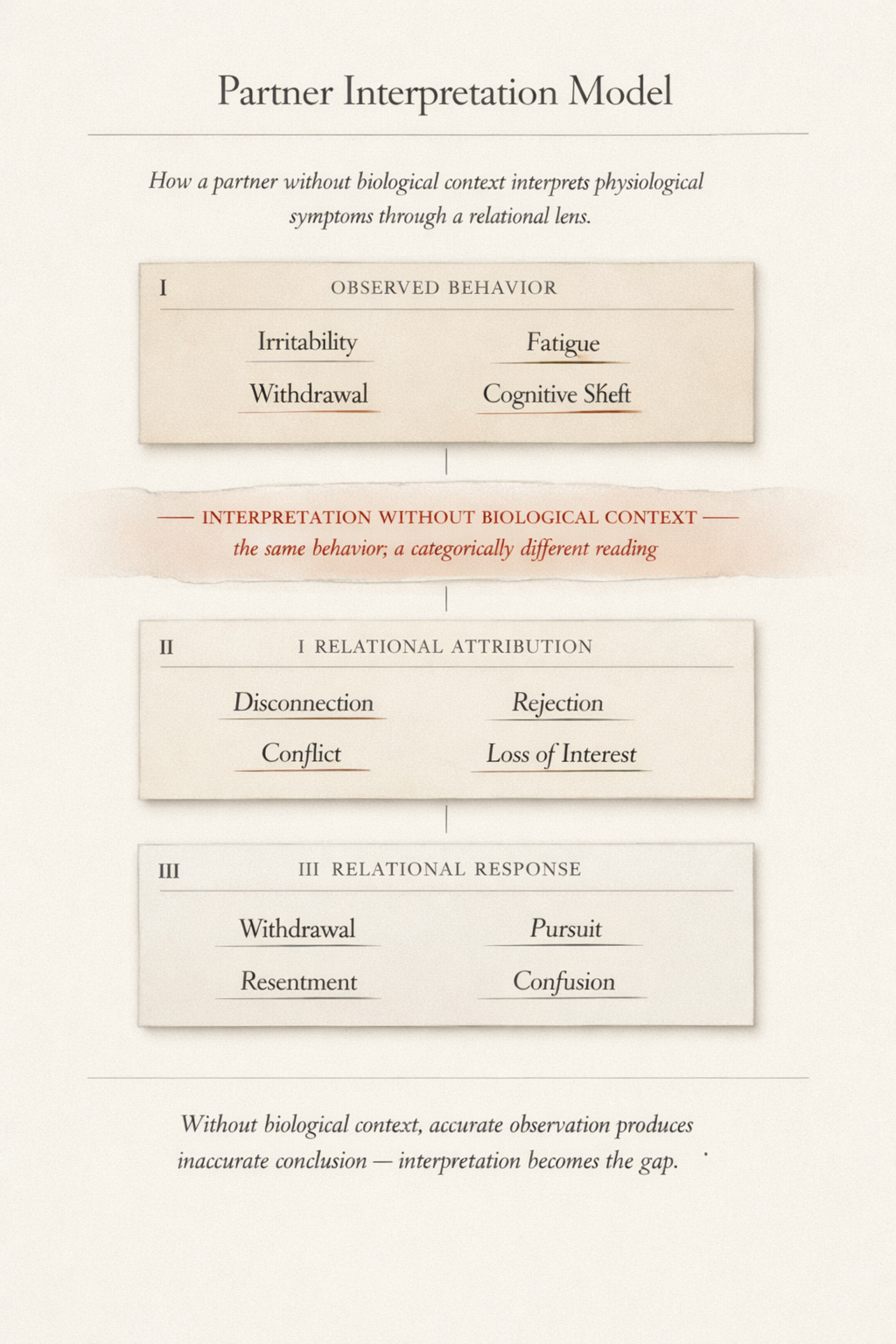
The standard interpretation of this dynamic is behavioral. One person is seen as becoming withdrawn, irritable, or unpredictable. The other is seen as either becoming intrusive and anxious, or distant and resentful. The problem is located in the individual: she has changed, or he is not responding correctly. From this perspective, the solution is also behavioral. She should explain what is wrong; he should listen better. He should give her space; she should be more inclusive.
This assumes the problem is a failure of communication or a lapse in character. It presumes that both individuals have access to their previous levels of patience, generosity, and relational capacity. It assumes the person who has changed can articulate the change. Often, she cannot.
The Hidden System Dynamic
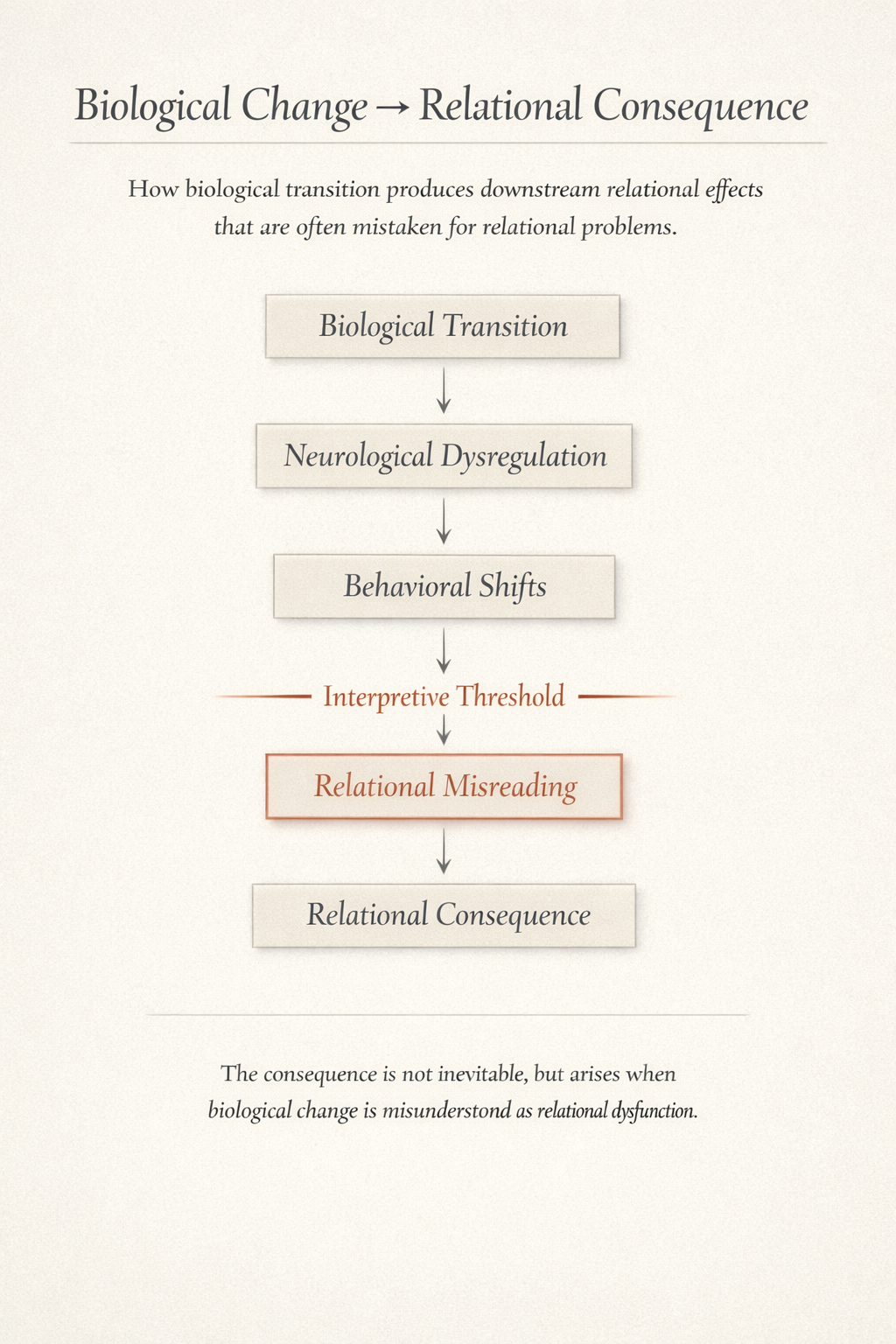
The menopause transition is not an event an individual goes through while their partner waits on the sidelines. It is a biological event that pressurizes the entire relational system. The fatigue, the cognitive fog, the somatic and emotional volatility are not just a collection of symptoms to be managed; they are new inputs that the system itself must now process. This introduces a specific kind of Relational System Stress that is physiological in origin but relational in expression. The system is absorbing a biological shock it was not designed for. It is trying to find a new equilibrium.
The Rise of Invisible Load
What looks like one partner’s moodiness is often the external expression of a profound internal workload. The body is recalibrating its fundamental operating system. This depletes resources. The available Emotional Bandwidth — the capacity to process relational demands, hold nuance, and extend generosity — contracts significantly. It contracts not out of spite or a failure of love, but as a matter of biological necessity. The energy is being used elsewhere. For the other partner, a new form of Invisible Relational Load emerges. This is the work of trying to decode a partner’s state, anticipating needs, managing the emotional climate of the home, and absorbing the small, daily frictions that now seem to appear from nowhere. This labor is intense, constant, and almost entirely unseen.
Pattern Development
Under this sustained, unnamed stress, a predictable pattern often emerges. The partner experiencing the biological transition begins to withdraw. This is not rejection. It is an attempt to conserve a dwindling supply of emotional and cognitive energy. The threshold for stimulation is lower. A conversation that would have been easy six months ago now feels like a drain. A simple request for a decision feels like a complex demand. The withdrawal is a protective, adaptive response to a system overload.
In response, the other partner often does the opposite. Sensing the distance, they increase their efforts. They initiate more conversations. They ask more questions. They try to “fix” the silence. This is the Overfunctioning and Withdrawal pattern. One person’s attempt to conserve energy is interpreted by the other as a problem to be solved, prompting an increase in energy expenditure that only makes the first person withdraw further. He tries to plan a weekend away, a gesture of connection, and is met with a flat refusal that feels personal. For her, the thought of packing, traveling, and being ‘on’ for a weekend is an exhaustion she cannot begin to articulate. The system polarizes. Both are trying to preserve the connection, but their strategies now work against each other.
The Logic of Overfunctioning
The overfunctioning partner is not being controlling. They are responding to a perceived threat to the relationship's stability. When one part of a system reduces its output, another part often ramps up its own to compensate, attempting to maintain the system's previous status quo. This response is logical. It is also, in this context, ineffective. It adds more demand to a system that is already overloaded. The more one partner pushes for connection and reassurance, the more the other experiences that push as a demand, further depleting the very capacity the first partner is hoping to access. The pattern is self-perpetuating, and it is exhausting for both people inside it.
Why Traditional Advice Often Fails
The failure of most relational advice in this context is a failure of sequencing. Advice centered on communication skills, shared activities, or behavioral change is a form of optimization. It seeks to make the relationship work better. But a system under sustained biological and relational stress does not need optimization. It needs stabilization first.
This is not a communication problem. It is a capacity problem. Asking two people operating with severely depleted Emotional Bandwidth to implement more skillful communication techniques is like asking an overloaded circuit to carry more current. The advice itself is not wrong. The conditions make it unworkable. The attempts often fail, reinforcing a narrative that the relationship itself is failing, that the individuals are not trying hard enough, or that the love is gone. The failure is not in the effort. It is in applying an optimization strategy to a stabilization problem.
Stabilization and Reframe
A more functional approach begins with a reframe. The central dynamic is not a relationship problem; it is a biological transition that the relational system was never designed to absorb without interpretation. This shifts the diagnostic question. The goal is not to fix the behavior but to stabilize the system so that the biological transition can proceed without causing catastrophic relational damage.
Stabilization means reducing the load on the system. This is not about grand gestures. It is about reducing demands, simplifying logistics, and externalizing household and cognitive labor where possible. It is about a shared understanding that the system is running on low power and must be managed accordingly. It requires a radical lowering of expectations for a period of time. This does not mean accepting a permanently diminished relationship. It means recognizing that a period of acute biological flux is not the time to measure the relationship’s long-term health. The body does not ask for permission to change.
Closing Reflection
Naming the dynamic does not make it disappear. Understanding that the system is under load does not restore the depleted energy or erase the feeling of distance when you are sitting in the same room. The explanation, however accurate, can feel thin and academic when the exhaustion is real and the silence is present and nothing feels different tonight.
But misinterpreting a biological system problem as a personal or relational failure produces one kind of story. It is a story of blame, disappointment, and a future that feels like it is closing down. Recognizing it as a system under a temporary, if prolonged, state of siege produces another. This does not make the daily experience of it less difficult. It does not provide a map for how to get through it. Many people feel the lack of a map as a failure in itself, as if clarity should produce a clear path.
Recognizing the nature of the problem changes the story being told about it. Neither guarantees resolution.